


E3 released a new white paper for Amazon that examines, (1) how utilities can effectively design electric rates to serve large and fast-growing loads such as data centers, and (2) case studies analyzing the utility impact of specific Amazon data centers. The study, Tailored for Scale: Designing Electric Rates and Tariffs for Large Loads, finds that the Amazon data centers evaluated are not being subsidized by other customers on an individual facility level and, in some cases, have generated surplus utility revenues (defined as revenue above the utility’s cost to serve that specific data center) that can create benefits, such as downward pressure on rates.
This finding is based on case studies of Amazon data centers in four utility territories: Pacific Gas & Electric (California), Umatilla Electric Cooperative (Oregon), Dominion Energy (Virginia), and Entergy (Mississippi), representing a wide range of sites, geographic regions, and market structures and sizes. E3 compared each facility’s projected utility revenue (i.e., electricity bill payments) to the estimated utility cost to serve the facility and assessed the delta in 2025 and 2030. Across all cases, E3 found that the data centers generate sufficient revenue to cover their costs and, in many instances, generated surplus revenue, providing a potential net benefit to other ratepayers. For an assumed 100 MW facility, E3 projected $3.4 million in surplus utility revenue would be generated in 2025 and $6.1 million in 2030. While the use of this additional margin is at the utility’s discretion and may be subject to regulatory approval, it can reduce the revenue required from other customers and thus lessen their cost burden.
To continue to prevent-cross subsidization and maintain these equitable outcomes, utility rate design must adapt and evolve given the rapidly increasing pace and scale of this load growth. This is particularly applicable to those utilities or broader regional markets that are seeing large load growth demand at a macro level that is shifting, or will shift, the fundamental supply and demand balance in the short- to medium-term.
Utilities have a range of tools available to them to mitigate risks to ratepayers and ensure the communities they serve reap benefits of large load growth. These can include:
- Identifying and managing risks proactively with mitigation tools, such as contract minimums and upfront deposits, to protect ratepayers while balancing other priorities, such as economic development and community benefits.
- Enabling flexible and customer-side solutions such as on-site generation and energy storage to allow new facilities to connect sooner while reducing the need for expensive new infrastructure.
- Reforming interconnection queues and timelines to help utilities plan more efficiently and discourage speculation.
- Embedding transparency and flexibility in tariffs, interconnection processes, and contract structures to ensure fairness, enable innovation, and manage uncertainty.
- Updating tariffs more frequently to reflect the latest cost-of-service, ensuring rates keep pace with load growth and changing system costs.
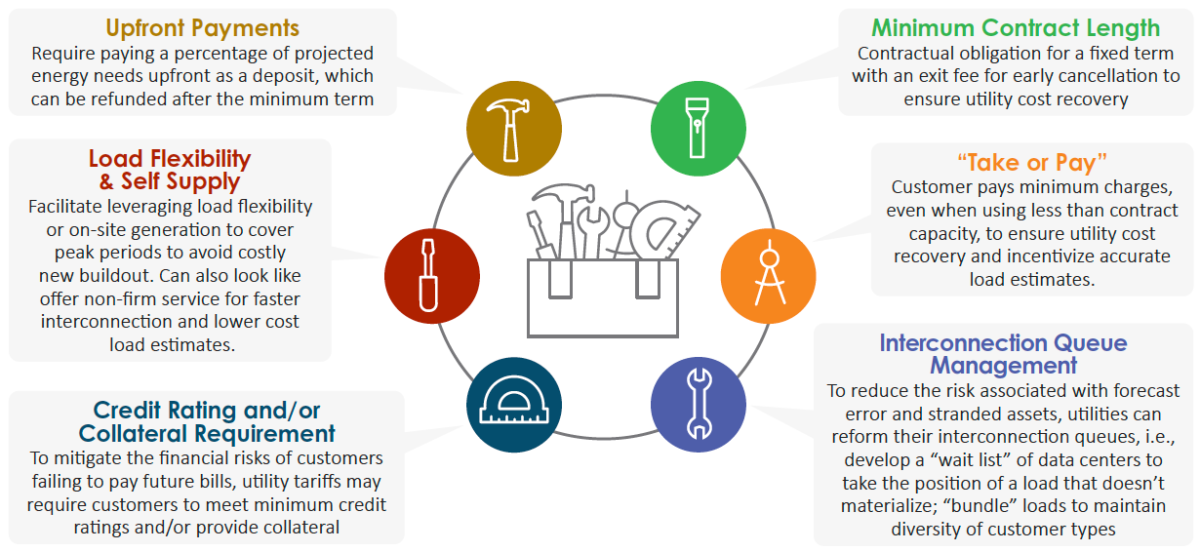
Large loads, utilities, and power producers are already innovating to address current barriers, such as capacity constraints. These include novel technologies and creative contract structures, such as tariffs to directly support new clean energy development including new breakthrough technologies. It also includes utilizing existing capacity more efficiently such as employing both traditional and emerging sources of demand flexibility and on-site generation.
E3’s findings are consistent with our groundbreaking 2024 study for the Virginia Joint Legislative Audit and Review Commission (JLARC), which examined the statewide impacts of data center growth on Virginia’s electric system and customer rates. That analysis similarly found that while large customers have not historically increased costs for others, the cumulative effects of rapid load growth will test existing rate structures and market constructs over time. In markets experiencing the fastest macro-level demand growth, rate design and cost allocation methods will need to evolve more quickly to keep pace with changing system costs. That is a broader policy and societal issue, versus the narrower issues associated with rate design and cost allocation, especially at the facility level. Ultimately, continued innovation, through updated tariffs, transparent cost recovery, and new approaches to market design and planning and contracting will be key to ensuring utilities and markets can meet rising demand while maintaining fair outcomes for all customers.
Read the report >
Authored by Kush Patel, Liz Mettetal, Isabelle Riu, and Morgan Santoni-Colvin. To learn more about E3’s work on large-load rate design, contact kushal.patel@ethree.com.
