


Rhode Island has released its 2025 Climate Action Strategy, finalized and approved by the state’s Executive Climate Change Coordinating Council (EC4) on December 18, 2025. EC4 agencies led the development of the Strategy over the course of the last fourteen months, with E3 supporting EC4 by leading the technical modeling that underpins many of the plan’s key insights. The 2025 Climate Action Strategy represents a major milestone in implementing the Rhode Island Act on Climate, which was enacted in 2021 and establishes mandatory economy-wide greenhouse gas (GHG) emissions targets, including a 45% reduction below 1990 levels by 2030, an 80% reduction by 2040, and net-zero emissions by 2050. The Strategy serves as the state’s comprehensive plan for GHG emissions reductions and is required to be updated every five years.
The 2025 Climate Action Strategy’s development included robust stakeholder engagement, detailed emissions modeling, and an analysis of costs, health impacts, and workforce needs to support decarbonization in Rhode Island. E3 led the rigorous technical analysis underlying the GHG emission pathways and potential near-term carbon reduction strategies included in the plan.
Key findings from the 2025 Climate Action Strategy include:
Progress Toward 2030 Target
Rhode Island is within reach of its 2030 emissions reduction target of 45% reduction below 1990 levels if the state successfully implements current state policies and programs as originally designed, however, there are significant uncertainties on the future of certain climate programs given federal headwinds. Meeting this target will also require several enabling conditions beyond state programs, such as the expansion of regional markets and supportive infrastructure.
To achieve the 2030 target, decarbonization of the electric grid, transportation electrification, building electrification, energy efficiency, and carbon sequestration from Rhode Island’s existing natural land sinks will all need to contribute to emissions reductions.
Key Uncertainty in the Face of Shifting Federal Landscape
The discontinuation of many federal clean energy policies and programs has created additional unknowns and challenges for climate action in Rhode Island. Through the One Big Beautiful Bill Act (OBBBA) and related actions, the current administration cut federal funding for state energy programs, rolled back federal emissions standards, and ended key clean energy incentives. A report issued in October 2025 by Governor McKee’s office of Management and Budget estimates that OBBBA cut over $75M in federal funding for Rhode Island energy projects and research. The current presidential administration has also ended the clean energy incentives provided by the Inflation Reduction Act, including a $7,500 tax credit for the purchase of an electric vehicle. As a result of these changes, Rhode Island is experiencing increased costs, slower project development, and weakened uptake for renewable energy, energy efficiency, heat pumps, and electric vehicles.
Additional GHG Reduction Strategies
Beyond the continued implementation of existing climate policies in Rhode Island, the state can pursue several additional GHG reduction strategies to jump-start the deeper emissions reductions needed for 2040 and 2050, while maintaining momentum toward its 2030 goals amid federal headwinds. E3 modeled 18 potential strategies and their GHG reduction impact as part of the RI Climate Action Strategy development. If implemented in the near-term, these strategies can also provide further GHG reductions by 2030, which will be important in the face of near-term uncertainty around current policy implementation and federal headwinds.
Shift in Technology and Energy
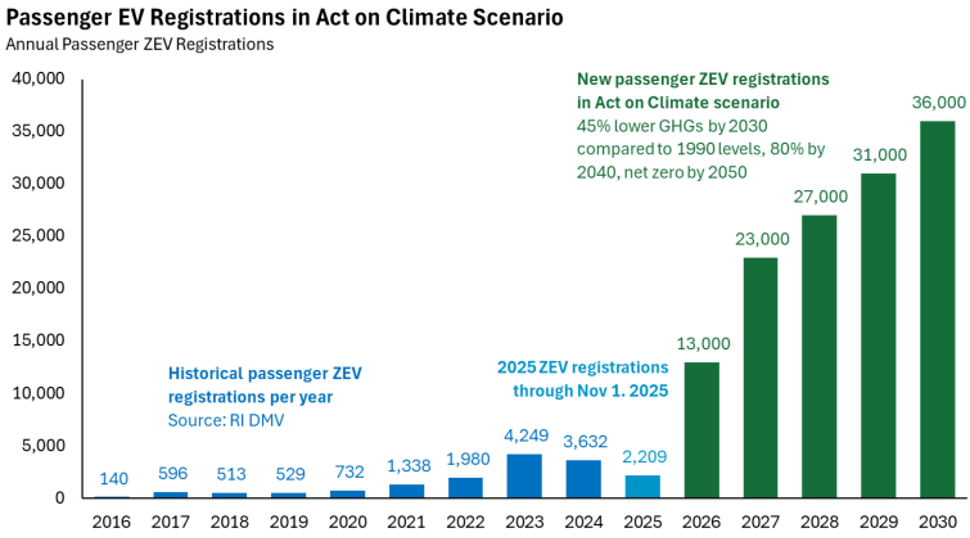
The modeled pathway for reaching RI’s Act on Climate shows a shift in how Rhode Islanders use technology and energy, including an increase in energy efficiency, heat pump, and EV adoption, and a transition away from direct fossil fuel use toward increased electricity demand. For example, in the Act on Climate scenario (the most aggressive modeled pathway), annual EV registrations increase from 2,200 in 2025 to 13,000 in 2026, and up to 36,000 by 2030.
Costs and Benefits of Decarbonization
Economy-wide decarbonization in Rhode Island will entail both costs and benefits. Incremental costs include investments in new infrastructure and technology deployment, such as electric grid upgrades and heat pump purchases. Benefits include savings on conventional fuels, like gasoline from switching to EVs, as well as improvements to public health.
EC4 Next Steps: Building on Existing Climate Programs
Going forward, EC4 identifies advancing climate policy while maintaining customer energy affordability as a key priority. Rhode Island has several funding options and potential updates to existing climate programs and policies that could continue to drive emissions reductions despite federal headwinds, while maintaining affordability and equity, including but not limited to:
- Focusing on pre-weatherization to ensure more households can benefit from energy efficiency
- Launching a commercial-scale energy storage program
- Engaging with RI auto dealers to increase availability of EVs
- Codifying into law Governor McKee’s Lead by Example Executive Order to reduce GHG emissions in the public sector and government facilities
- Continuing to invest in the Clean Heat RI program to provide customers with heat pump incentives and the state EV rebate program to advance EV and e-bike adoption
- Pursuing a Clean Energy, Green Economy, Resilience Bond on the 2026 ballot
Looking Ahead
The Strategy provides state leaders with a framework for understanding key considerations for various pathways for RI’s future: emissions reductions and key uncertainties under current policies, impact of federal headwinds, additional GHG reduction strategies that RI could pursue to accelerate reductions, potential technology adoption and costs under an Act on Climate future, and how electrification could affect household costs and equity.
E3 is proud to have supported Rhode Island EC4 with the technical analysis for their 2025 Climate Action Strategy and looks forward to continuing to work with states and regions as they work to advance climate policy while balancing reliability and affordability – especially in the face of federal policy hurdles.
