


E3 recently supported the City of Palo Alto (“the City”) with a set of models and studies to help the City develop policy options for achieving large-scale building and transportation electrification affordably. This effort is inspired by the City’s ambitious climate target of reducing community-wide greenhouse gas (GHG) emissions 80% below 1990 levels by 2030 (“80×30”).
Cost remains one of the biggest barriers to widespread electrification for cities and municipal utilities nationwide. These studies and tools, funded in part by a grant from the American Public Power Association, were designed to develop a practical framework and toolset that other municipalities and publicly owned utilities can use to plan and finance electrification at scale.
E3 and its partners evaluated electrification opportunities, EV infrastructure needs, and, importantly, funding strategies across all major building sectors and transportation. The team then integrated these studies into a Funding Model, which we used to develop illustrative scenarios to highlight various financial dynamics of large-scale electrification. These efforts are embodied in six interrelated reports:
- Funding & Financing Study
- EV Charger Needs Assessment
- Single-Family Residential Electrification Study (in partnership with Rincon Consultants)
- Multifamily Residential Electrification Study(in partnership with Willdan)
- Non-Residential Electrification Study (in partnership with Willdan)
- Funding Source Survey
Understanding Community-Wide Costs and Benefits
At the core of this effort is the Funding Model E3 developed to explore the financial tradeoffs of community-wide electrification. This model quantifies the direct monetary costs and benefits of electrification under three illustrative scenarios – High, Medium, and Low Local Action – each reflecting different speeds of building and transportation electrification and varying levels of City investment toward electrification efforts. E3 developed the model as a flexible tool the City can continue to use to evaluate alternative strategies and inform future policy and funding decisions.
E3 used the Funding Model to develop three illustrative scenarios for community-wide electrification, summarized in the Funding & Financing Study. A key finding under the assumptions used is that electrification provides a net financial benefit to the Palo Alto community over time. These benefits are driven primarily by avoided gasoline and diesel costs from transportation electrification, which outweigh ongoing community costs, including charging and electric supply costs. These findings may change as assumptions are updated in the dynamic policy environment climate efforts are currently experiencing, and the Funding Model provides the tools the City can use to update its assumptions and consider different policy options.
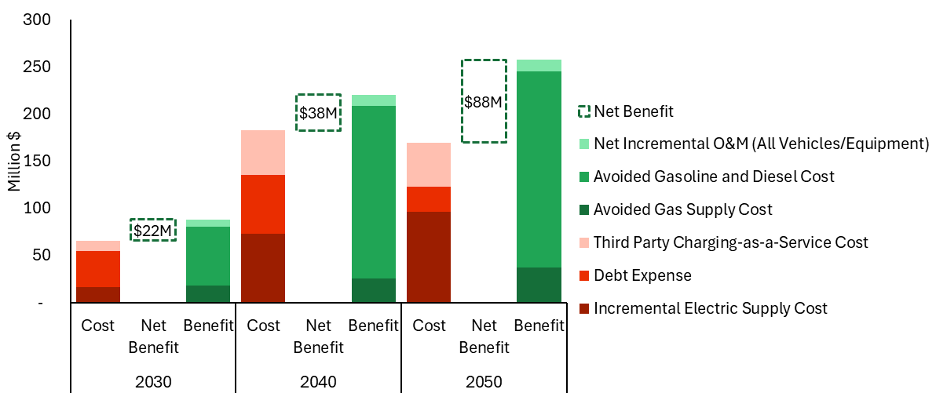
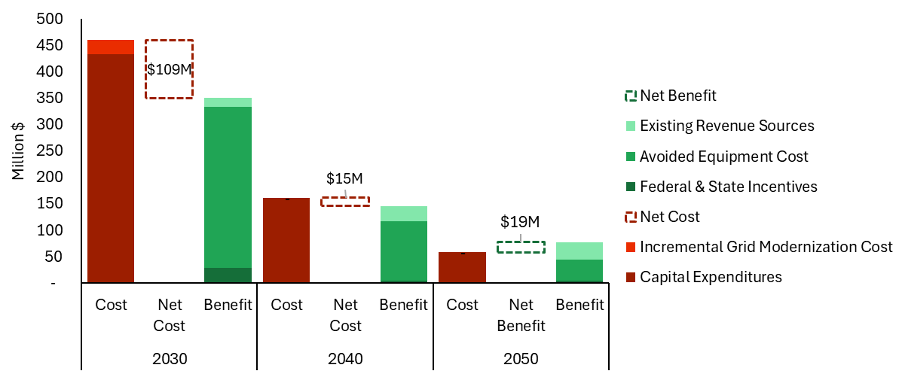
The long-term benefits of electrification require substantial upfront capital investment, particularly for electric equipment and supportive infrastructure. The scale of this investment depends on both the pace and extent of electrification. Under the High Local Action scenario (shown below), an ambitious scenario involving rapid and widespread action by the community, the rapid pace of electrification would require early retirement of existing fossil fuel building equipment, meaning traditional heaters and appliances would be replaced with all-electric alternatives before reaching the end of their useful lives. This upfront cost would need to be financed through municipal and/or utility bond issuance or alternative cost-recovery mechanisms.
Sector-Specific Studies: From EV Charging to Buildings
To complement the funding analysis, E3 developed an EV Charger Needs Assessment, which evaluates the scale and timing of charging infrastructure deployment needed to support Palo Alto’s transportation electrification goals, and provides a modeling framework to iterate different EV adoption scenarios. The assessment examines residential, workplace, and public charging needs to help align charging infrastructure investments with anticipated EV adoption.
In parallel, sector-specific building studies provide details on electrification pathways across Palo Alto’s diverse building stock. The Single-Family Residential Study, developed with Rincon Consultants, and the Multifamily Residential and Non-Residential Studies, developed with Willdan, assess technology options, costs, adoption barriers, and infrastructure needs across residential and commercial buildings to identify the most promising electrification opportunities.
These subsector studies highlight important considerations by sector: while EV adoption often delivers significant lifetime cost savings for individual households, building electrification can show increased lifecycle costs for first installation, especially for homes without existing air conditioning. These findings underscore the importance of well-designed funding and financing strategies to enable equitable participation.
Identifying Funding & Financing Mechanisms
The Funding Source Survey examined a wide range of potential mechanisms the City could use to support community-wide electrification, including local, state, and federal funding sources and utility and municipal funding and financing approaches designed to reduce upfront costs for residents and businesses. Palo Alto is unique as a provider of both gas and electric service, which broadens the types of programs and revenue sources that may be available.
This work identified which funding and financing options are already available, which new mechanisms could be legally and operationally scalable, and which approaches align best with Palo Alto’s climate goals. The analysis is grounded in real-world funding constraints, and provided the context and foundation for the modeling work.
E3 is proud to support the City of Palo Alto in advancing community-wide electrification strategies that balance climate ambition with affordability, equity, and long-term economic benefits, and we look forward to partnering with additional municipalities and municipal utilities as they consider widespread electrification and the funding and financing solutions needed to achieve it.
Authored by Amber Mahone, Jared Landsman, Molly Bertolacini, Samantha Lang, Hannah Platter, Paul Picciano, Caitilin McMahon, Isabelle Riu. Please contact amber@ethree.com to learn more.
