

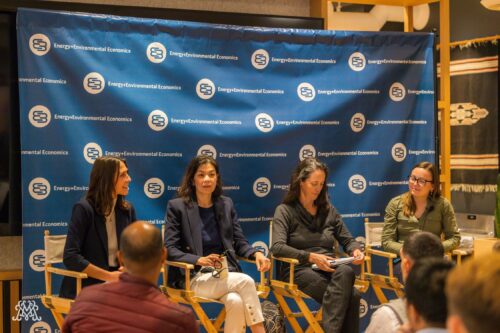
During San Francisco Climate Week, E3 hosted a panel discussion on one of the central questions facing California’s power sector: how to advance the state’s ambitious decarbonization goals amid growing cost and climate change pressures. Rising electric rates dominate the headlines, devastating wildfires are reshaping communities and energy infrastructure planning, and clean energy developers are navigating siting, permitting and federal policy headwinds.
Moderated by E3 Managing Partner Amber Mahone, the conversation brought together leaders working on the issue from different angles: Merrian Borgeson, Policy Director for California Climate and Energy at NRDC; Anna Brockway, Interim Lead for Climate Adaptation and Resilience Planning at Southern California Edison; and Rohimah Moly, Deputy Director of Energy and Climate at the Governor’s Office of Business and Economic Development. The discussion focused on where California is making progress and what additional solutions are still needed.
Key takeaways included:
- Climate impacts are already changing how the grid is planned and operated.
Wildfire remains one of the most visible threats, but it’s only part of the picture. Anna Brockway described how extreme heat, flooding, precipitation, and sea level rise are creating new pressures on grid infrastructure. Higher temperatures increase demand, but they also degrade equipment, reduce conductor efficiency, and put more stress on transformers. Climate change is both increasing the need for electricity while also making the grid system itself harder to maintain; highlighting the need for investment in long-term climate adaptation solutions. - Affordability is a real problem, but clean energy is not the reason rates are high.
The discussion pointed to wildfire-related costs and legacy rate design decisions as important drivers of today’s affordability challenge. Panelists emphasized that clean energy itself is not the driver of California’s high electricity rates. - Some of the best solutions are not especially flashy.
Merrian Borgeson offered clear examples of this, walking through five policy ideas NRDC is especially encouraged by right now: staffing permitting agencies so energy project reviews can move faster; making it easier to site solar on certain water-constrained agricultural lands; reforming aspects of the California Environmental Quality Act (CEQA) to enable certain energy projects to move forward more quickly; central procurement for transformers and other critical grid equipment; and state support for early geothermal exploration. Her point was that California does not need one grand fix so much as a steady push on the smaller changes that remove friction from the system. - California is working to improve permitting and interconnection processes, especially as projects move into new communities.
Moly spoke about the state’s work to make local permitting more consistent across California’s many jurisdictions, including model ordinances, guidance for local governments, and the forthcoming California Permitting Academy. As more projects are proposed in places with less experience hosting energy infrastructure, local governments and communities need clearer processes and better information. That came up especially in the discussion of battery storage, where public concerns have grown in the wake of high-profile fire incidents. Panelists agreed that storage is essential, and that implementation of current construction and safety standards mitigate most of these risks, along with early community engagement, also essential. - The last stretch of decarbonization may be the hardest.
The panel also looked ahead to what comes after the current wave of solar and battery buildout. Brockway noted that as electrification accelerates, winter peaks are beginning to catch up with summer peaks even in sunny Southern California, which raises new questions about what kinds of resources will be needed to maintain reliability and resiliency of the grid. California will need to keep investing in renewables and storage, while also figuring out which clean firm resources can help fill the remaining gap.
The conversation offered a useful reminder that California’s path forward will likely depend less on dramatic gestures and more on careful, persistent work: better planning, faster permitting, stronger supply chains, smarter interconnection, and genuine engagement with communities being asked to host the infrastructure of the energy transition.
Sign up for invitations to future E3 events here:
