


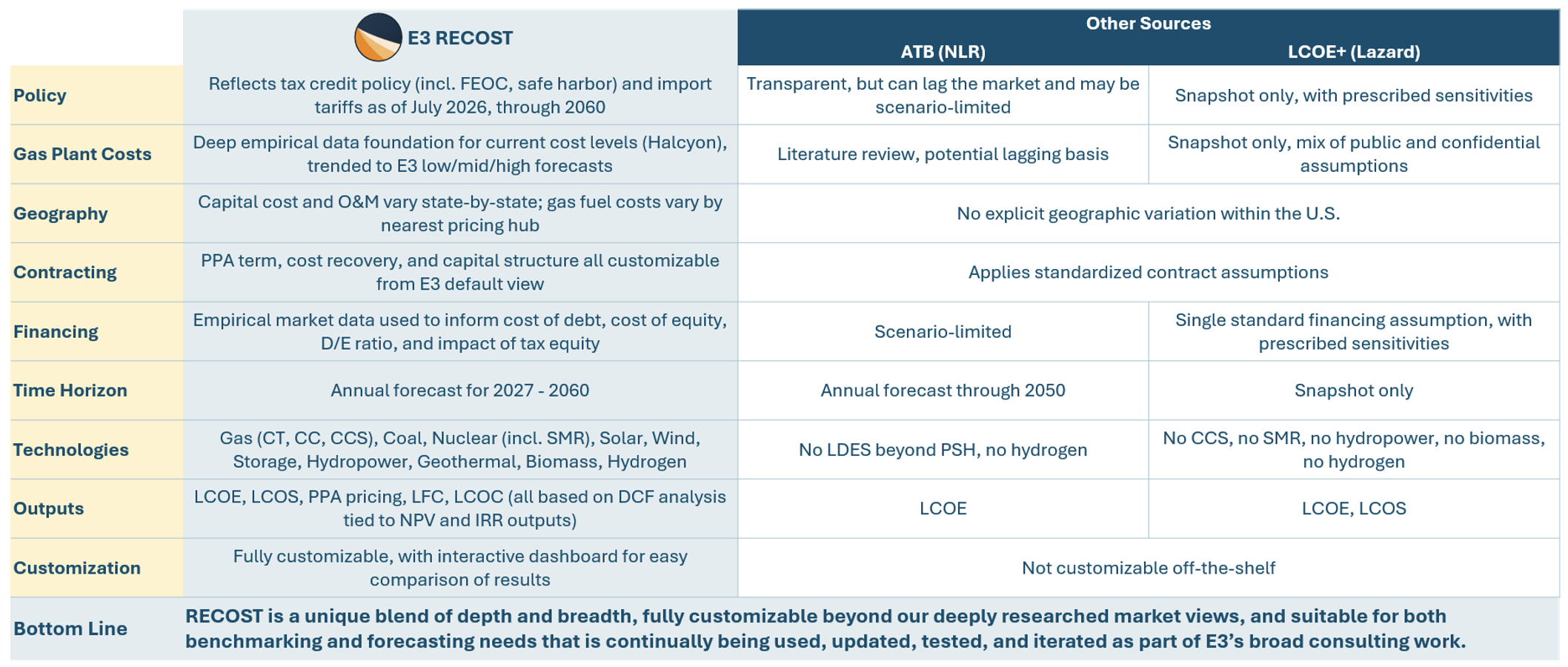
E3 has updated our Resource Cost (RECOST) model, a discounted cash flow tool that calculates the levelized cost of different energy resources through 2060, differentiated for every state in the U.S. and every province in Canada. This update reflects the ongoing volatility impacting resource costs across electricity markets. As in prior releases, our forecasts draw on the Gas Power Plant Tracker from our partner Halcyon.
What is RECOST?
RECOST is E3’s discounted cash flow model and database used to calculate the levelized costs of different candidate resources, from the present through 2060. Since 2010, E3 has regularly built and released formal public databases and levelized cost calculations for our clients. Now, RECOST is the foundation of our generation supply costing analysis: used in the Integrated Resource Plans of utilities, the long-term scenarios of state agencies, and the project or portfolio forecasts of investors and developers negotiating PPAs and planning their project pipelines.
How We Think About Calculating Resource Costs
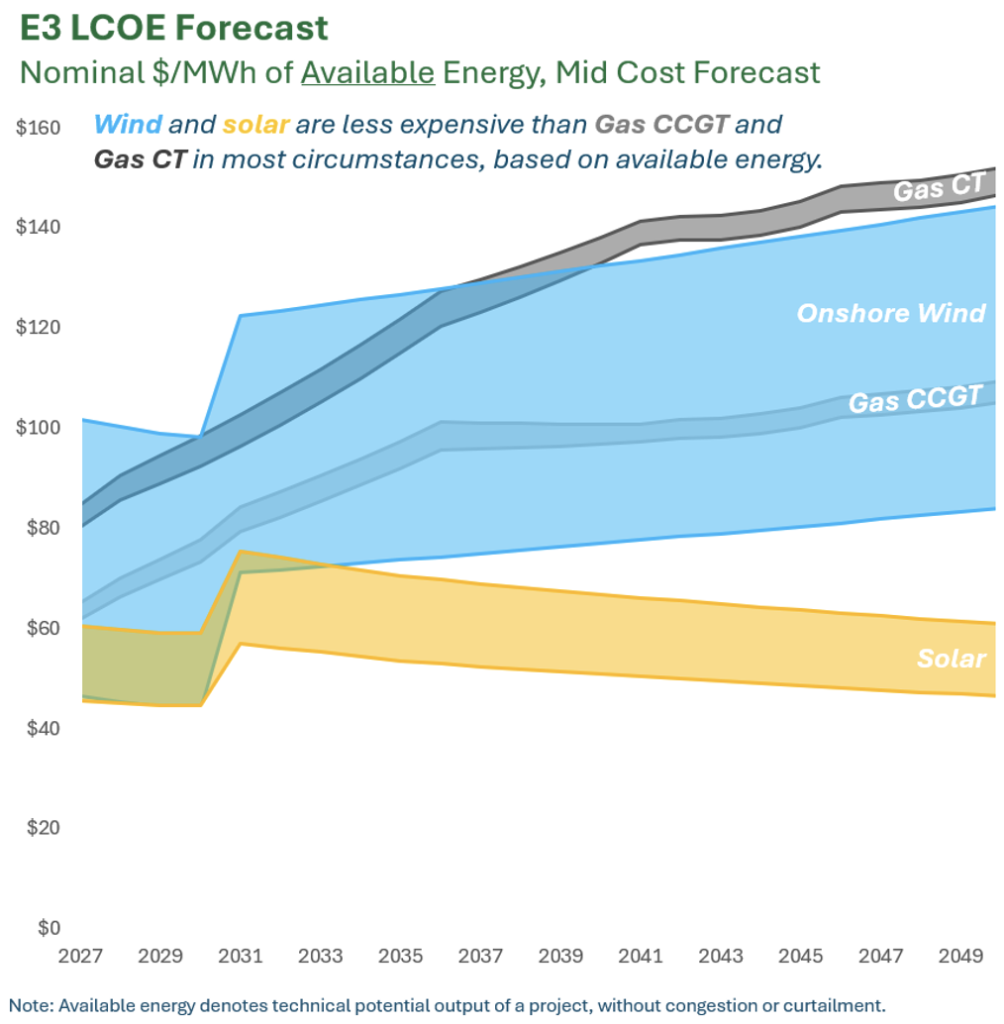
E3’s latest RECOST market report dissects two common misapplications of economics to resource costs. The first concerns the Levelized Cost of Energy (LCOE), which is often defined for dispatchable resources around a specified capacity factor. This is technically incorrect: the economics of a resource are defined by its available energy. For renewable resources like wind and solar, available energy is similar to the common understanding of capacity factor, adjusted only slightly for factors like resource availability and curtailment. For dispatchable resources, however, the gap between available energy and actual output can be dramatic: a gas combustion turbine may be available for more than 80% of hours in a given year yet dispatched for only 10%, depending on hourly market price signals.
The second concerns Levelized Fixed Costs (LFC), often used to define an asset’s capacity value in public analyses. This is likewise incorrect for planning purposes: the right metric for the cost of new capacity should account for the capacity accreditation specific to a given market. A common term for this is Levelized Cost of Capacity (LCOC).
Definitions may seem like the driest topic in resource planning, but they are fundamental to valuing any resource accurately. Below, we show our latest LCOE forecast based on available energy, alongside our latest LCOC forecast based on a range of actual capacity accreditation assumptions from different U.S. markets. The full details behind these charts are in the RECOST report.

What’s New in This Release?
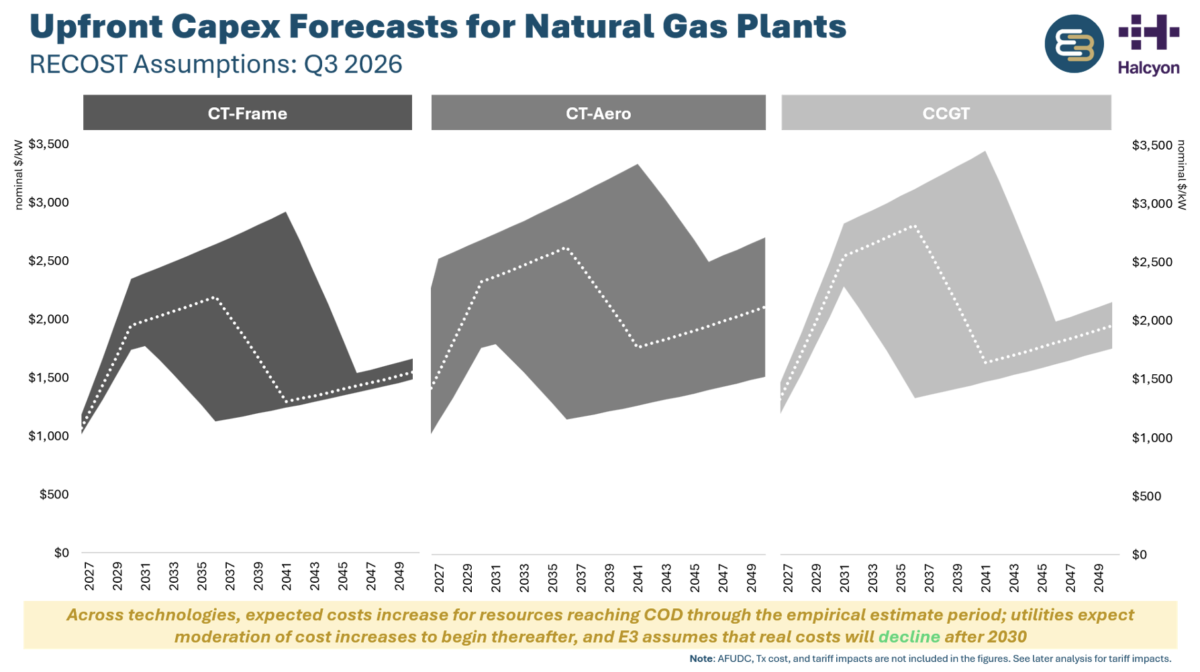
What Goes Up, Must Float Down? Gas Plant Cost Trends
Natural gas plant costs remain significantly elevated, with no sign of abatement in capital costs this decade. How long the underlying pressures will persist remains uncertain – on the demand side, primarily from large load customers, and on the supply side, primarily from manufacturing capacity. Drawing on the latest data from our partner Halcyon, as well as our ongoing engagement with market stakeholders, we have revised our natural gas capital cost forecasts to reflect significant moderation of these costs in the 2030s, varied across scenario.
We have also added geographic differentiation to natural gas fuel costs, matching the state-level granularity of our other resource cost inputs. RECOST now links each project’s state to the nearest natural gas pricing hub and applies a delivery adder, producing a more realistic delivered gas price for LCOE calculations that can be applied across the U.S.
Import Tariffs: The Supreme Court Strikes Back
On February 20, 2026, the Supreme Court struck down the International Emergency Economic Powers Act (IEEPA) tariffs, and a process for refunding tariff payments to affected companies has since been announced. E3 has accordingly lowered its default tariff rates in RECOST. However, several tariffs remain in effect, and multiple duties can still stack on a single imported component. To reflect this uncertainty, RECOST provides a range of low-mid-high tariff rates.
New Interactive Dashboard: User Flexibility Meets E3 Expertise
E3 now offers a fully interactive dashboard with all RECOST results, viewable in any browser, allowing for much easier customization of results for different contexts. See a sample here.

Learn More
RECOST is available for purchase here.
For more information, please reach out to E3 at marketprices@ethree.com.
