


Whether data centers raise rates for everyone else is one of the most contested questions in the sector, and most of the available evidence is correlational. E3’s June 2026 white paper sponsored by CloudHQ, Beyond the Headlines: An Empirical Analysis of Data Center Grid Utilization, Cost-of-Service and Revenue Contributions, found no historical relationship between load growth and rising retail rates, and showed that under a modern large-load tariff like Dominion Energy Virginia’s GS-5, revenues from a large load exceed the cost to serve it in most modeled scenarios.
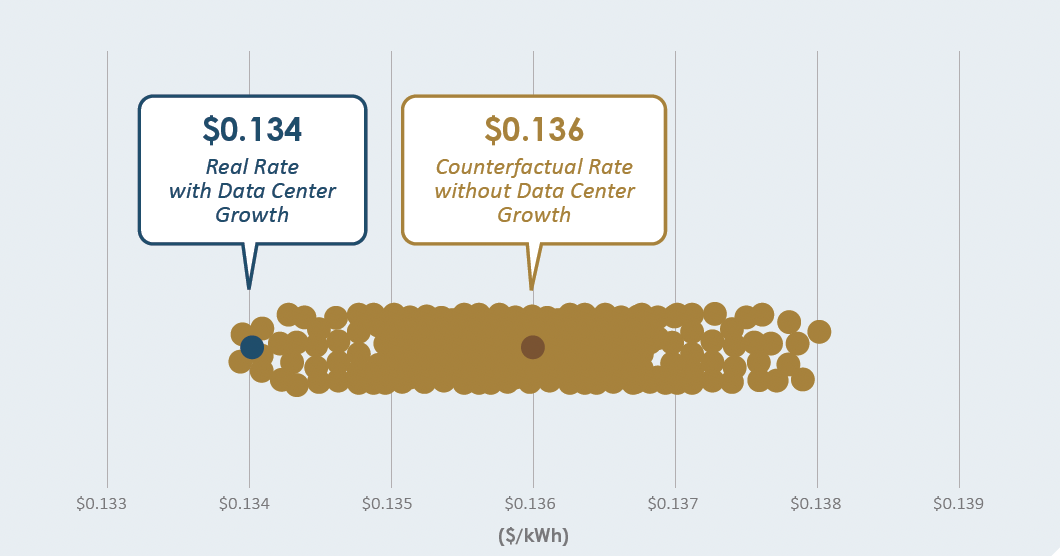
As a follow-up to that whitepaper, we modeled Dominion, one of the leading utilities in serving data center load, and asked what a Virginia residential customer would have paid in 2023 had the data center growth of the previous five years never materialized.
Answering that takes two steps. The first is establishing what Dominion would not have had to build. Removing the unanticipated data center load avoids gas capacity, transmission, and a portion of the solar built to meet Virginia’s RPS, which lowers the revenue requirement that all customers cover.
The second is establishing how that smaller revenue requirement would have been allocated. Utilities divide costs across customer classes based on how much energy each class consumes and how much it contributes to peak demand, so removing data center load changes every class’s cost responsibility, not only the total to be recovered. We rebuilt both steps from Dominion’s Biennial Review and rate case filings, then swept every uncertain input across low, base, and high values, producing more than 2,000 counterfactual scenarios.
In 98% of scenarios, residential rates were higher without the incremental data center load and in the mid-case scenario, the average customer saved $2 a month due to the associated load growth.
Cost allocation drives the result. In the mid case, serving incremental data center growth cost Dominion about $704 million, while allocation factors assigned data centers roughly $763 million of the 2023 revenue requirement. Their share of cost responsibility grew faster than the costs they imposed, and the difference went toward recovering infrastructure shared across all classes. That is consistent with Dominion’s retail rates having historically run below regional peers and the national average.
Will this always translate across other utilities? It depends on how a utility allocates costs, how it serves new load, and whether forecasted load materializes and operates at a high load factor. Where it does not, ratepayers face stranded cost risk from infrastructure built in advance, which is what large-load tariffs like GS-5 are designed to address. High load factor customers can put downward pressure on rates, given cost-of-service modeling and rate design that assign them their share.
Read the backcast analysis, or see a one-page summary.
Read the original white paper, Beyond the Headlines.
For further information on E3’s work on large loads and rate design, please contact kushal.patel@ethree.com.
