


MISO’s capacity auction, like many capacity markets, clears against a demand curve built around a reference technology, a resource type chosen to represent what it costs to add new capacity, which makes that choice a direct input to auction outcomes. MISO retained E3 to evaluate reference technology options beginning with Planning Year 2027-2028, and we filed the study to MISO’s Resource Adequacy Subcommittee stakeholder process in August. Alongside a comparison of eight candidate technologies, the study sets out a framework for how a reference technology should be selected in the first place.
A reference technology is a market design construct, used to set demand curve parameters. Selecting one does not endorse a resource type or predict what developers will build, since the market can meet the resulting prices with whatever resources it finds economic. There is also no single correct reference technology in the abstract, because the right choice depends on how the benchmark is used. PJM, ISO New England, and NYISO all select primarily on net cost of new entry, the cost the capacity market must deliver after a accounting for a resource’s energy and ancillary services revenues. MISO also uses the reference technology’s gross cost to set its auction price cap, so our framework weighs both.
In a market where developers can enter freely, no technology should stay the cheapest source of capacity for long. If one did, developers would keep building it until its energy revenues fell and its advantage closed. A functional market should therefore show several resources at roughly the same net cost, which means a reference technology study is unlikely to find a clear winner on net cost alone and needs other criteria to make the call.
MISO provided the eight candidates evaluated in the study: gas combustion turbines (frame and aero) and combined-cycle plants (F and H class), batteries of 4-hour and 2-hour durations, solar paired with storage, and coal. We developed costs in RECOST, E3’s levelized cost model, and drew energy revenue forecasts from MISO’s own system modeling. We evaluated each candidate on lifetime costs and revenues, since that is how developers assess an investment.
In MISO North and Central, a gas combustion turbine, combined-cycle plants, and 4-hour storage all landed similarly on net cost per megawatt of accredited capacity, which is the kind of clustering a competitive market should produce. When net cost cannot separate candidates, gross cost becomes the practical differentiator because it sets the price cap, and there the combustion turbine and 4-hour storage are lowest. In MISO South, the combustion turbine is lowest on both measures, with the next options about more than 6% higher. Coal comes in at roughly twice the cost of the next most expensive candidate in both regions.
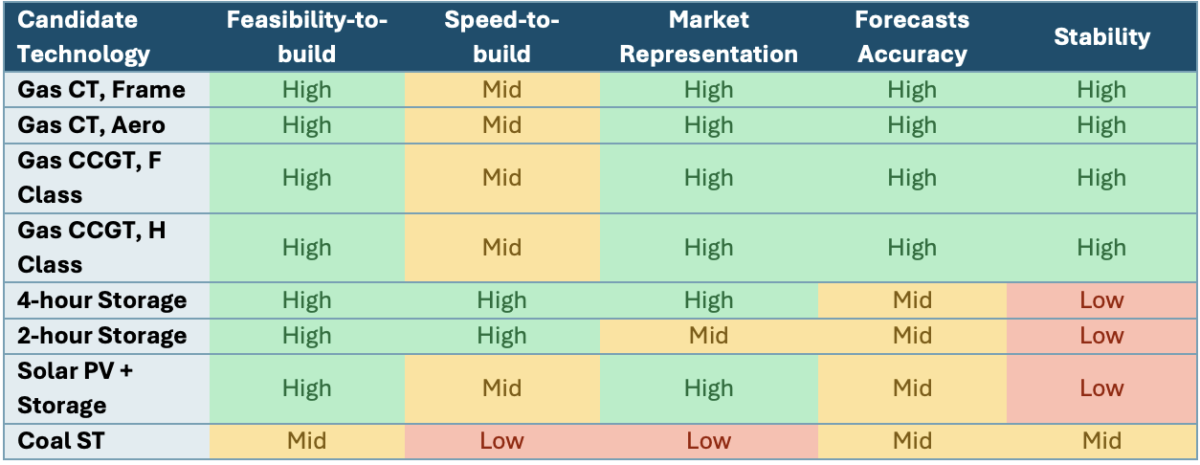
E3 also evaluated each technology qualitatively, based on five main criteria: feasibility-to-build, speed-to-build, market representation, forecast accuracy, and stability.
The study is an input to MISO’s final decision. MISO selects its reference technology and recalculates the associated values each year through an established process. The framework itself also carries beyond MISO, since any capacity market with an administratively set demand curve faces the same questions about what its benchmark represents and how to estimate it.
Download the MISO Reference Technology Study >
For further information on E3’s work in resource adequacy and capacity market design, please contact zachary.ming@ethree.com.
