

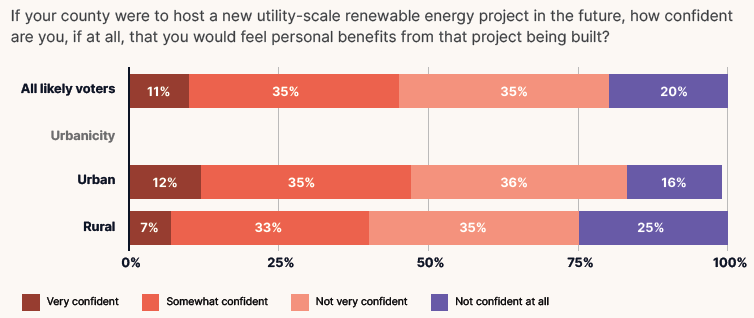
Local permitting barriers driven by community opposition have made constructing utility-scale wind and solar projects challenging across much of the U.S. Developers can help build support by demonstrating how their projects can benefit host communities, and property tax revenue is often the most concrete benefit a developer can offer. In many states, though, that revenue is hard to forecast, falls quickly as equipment depreciates, and reaches the community through channels residents rarely see. A June 2026 national survey by Data for Progress found that only 40% of rural voters felt even somewhat confident they would personally benefit from hosting a renewable energy project in their community. That’s a smaller share than among urban voters, even though most projects are built in rural areas.
To address this challenge, the Siting Solutions Project – an initiative of the nonpartisan, nonprofit organization Clean Tomorrow – released a new report titled See It to Believe It: Principles for Effective Clean Energy Tax Policy. The report evaluates how state-level property tax regulations affect whether host communities see and feel the benefits of clean energy, and identifies best practices across the country that states can adopt to better align developer and community incentives. E3 supported Clean Tomorrow as a research partner and led stakeholder outreach for the report.
With E3, Clean Tomorrow selected 24 state tax systems for review, and E3 grouped them three ways: whether the tax is based on a project’s assessed value or on attributes like installed capacity, whether those inputs are fixed or shift from year to year, and whether the state’s approach was built mainly around solar or wind. From those groups, E3 picked a representative set of states for outreach. E3 then conducted over a dozen interviews with developers, property tax specialists, trade associations, and local and state government representatives, and supported Clean Tomorrow with peer review and revision of the final report.
The report outlines four key principles associated with effective tax treatment for clean energy projects. These principles reflect what E3 heard repeatedly in interviews, where stakeholders also favored simple structures like flat capacity taxes and voluntary PILOTs:
- Transparency. Residents can see what a project will pay, how that amount is set, and how it will be used, both before construction and once the project is operating.
- Consistency. Predictable payments let local governments budget and even issue bonds against future revenue. They also give developers more certainty about their tax obligations.
- Flexibility. Local governments can direct revenue toward community priorities instead of distributing it strictly through standard taxing units.
- Additionality. Revenue is large enough, and flows to the right places, to make a real difference locally.
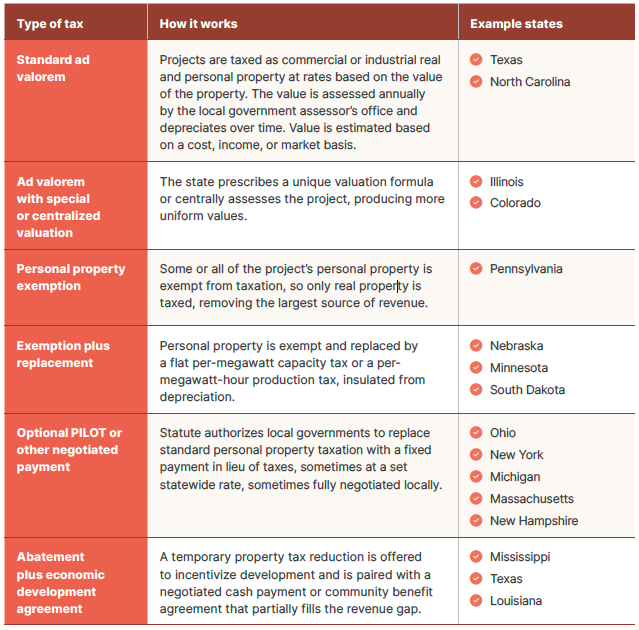
No state’s current approach covers all four principles, but the report profiles models that excel along several dimensions. Michigan’s statutory PILOT and Nebraska’s flat capacity tax, for example, replace depreciating personal property taxes with fixed per-MW payments. New York’s locally negotiated PILOTs are the most flexible, but the state’s tax formula is hard to work out, so local governments often agree to less than a project would otherwise owe. Colorado still taxes projects on their value, but it assesses every project with the same formula and spreads depreciation evenly over the project’s life, so revenue declines gradually. The right model depends on each state’s legal and political context, and tax reform works best alongside good-faith engagement between developers, local officials, and host communities.
The project builds on E3’s broader siting and permitting work, including a permitting toolkit for California local planners developed for GO-Biz, and several assessments of project siting feasibility in Hawaii conducted on behalf of the Hawaii Natural Energy Institute.
Read See It to Believe It: Principles for Effective Clean Energy Tax Policy >
To learn more about E3’s work on clean energy siting and community engagement, contact lakshmi@ethree.com.
