


California is facing sharply rising electricity rates at the same time its supply mix is shifting toward variable and energy-limited resources, moving reliability risk out of a few predictable summer peak hours and into less predictable hours year-round. Holding down rates in that environment requires using every cost-effective tool available. Flexible load can be one of them, if it is structured, measured, and compensated correctly. A new paper from GridLab, E3, and Kevala, informed by a year of stakeholder roundtables convened by UC Davis, lays out how California can consolidate a fragmented program landscape into standardized pathways that pay only for verified grid value.
The resource base is larger and more controllable than in any prior demand response era. California expects to procure 31 GW of utility-scale storage over the next 10 years. Enrolling just 10% of the 9.7 million light-duty EVs the CEC projects for 2036 in vehicle-to-grid service could supply roughly 30% of that cumulative procurement target, if those resources are accredited and operated on a basis comparable to grid-scale storage.
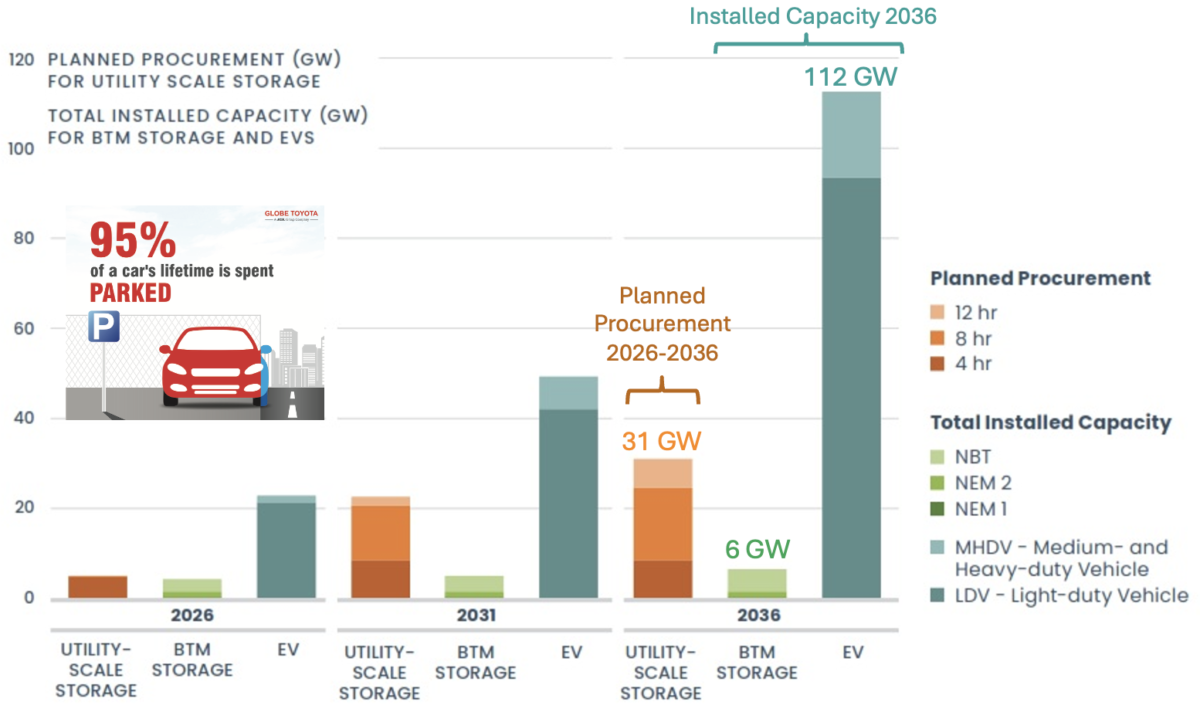
Any credible case for expanding flexible load compensation has to reckon with net energy metering. NEM was a calculated approach to building demand for a nascent technology, drawing more than 2 million customers and roughly 18 GW of installed capacity. Under California’s high volumetric rates, that retail rate credit has shifted costs to non-participating customers, raising their bills by an estimated $7 billion per year. CPUC and NRDC analyses attribute 12-19% of customer bills to that cost shift, on par with wildfire and distribution costs at 14-19%. The Net Billing Tariff has slowed the rate of this cost shift by reducing export compensation but still compensates self-consumption of PV generation and storage discharge well above avoided cost. Excluding NEM and NBT customers from new flexible load compensation is the cleanest way to make near-term progress. It sidesteps the equity challenge of paying more to customers already compensated well above the value they provide, and it avoids having to quantify the impact incremental to the response NEM and NBT already induce. The paper further describes two alternatives, full eligibility and conditional eligibility tied to a tariff transition, and none of the three substitutes for retail rate and NEM reform.
The paper emphasizes three principles:
- Compensation should be below avoided cost and pay only for value incremental to what rates already induce.
- Payment should follow measured performance during the critical hours that drive grid costs, rather than enrollment.
- Programs should consolidate onto a few well-defined products using open and interoperable standards.
The rules written now will govern a flexible resource fleet several times today’s size. Following these three principles is what makes distributed batteries, EVs, and smart appliances a real alternative to utility capital investment, without asking non-participating customers to absorb more cost shift.
Read the full paper >
For further information on E3’s work in demand flexibility, rate design, and distribution planning, please contact eric@ethree.com.
