


Long-term electricity planning in the West still relies largely on historical weather data. Yet climate change is rendering historical weather data less useful to inform long-term planning decisions.
Climate change affects both electricity demand and supply: impacting when and how much electricity people use, and shifting precipitation and storm patterns, reducing hydropower availability and potentially shifting solar and wind generation patterns. California’s grid planning processes have started to fold in climate data, but methods vary across agencies and best practices are still taking shape.
A new report from E3, and our research partners at Eagle Rock Analytics, Lawrence Berkeley National Laboratory (LBNL), and Kit Batten Consulting, with funding from the California Energy Commission (CEC) Electric Program Investment Charge (EPIC) program, investigates how the latest climate science data can be applied in a long-term resource planning context.
In the report, Climate-Informed Electric Grid Modeling for California and the West, we ask, “If the West planned around the weather that the latest climate models project, instead of the weather of the past few decades, would we build different grid resources in 2045?
The answer is yes, but only modestly. Summer peak demands are expected to increase by about 10% across the West due to climate change (see the figure below). In California, where climate change is expected to result in warmer winters, our results highlight a silver lining of climate change: building electrification will not have as big of an impact on winter-time electricity demands as planners would anticipate without factoring in climate change data.
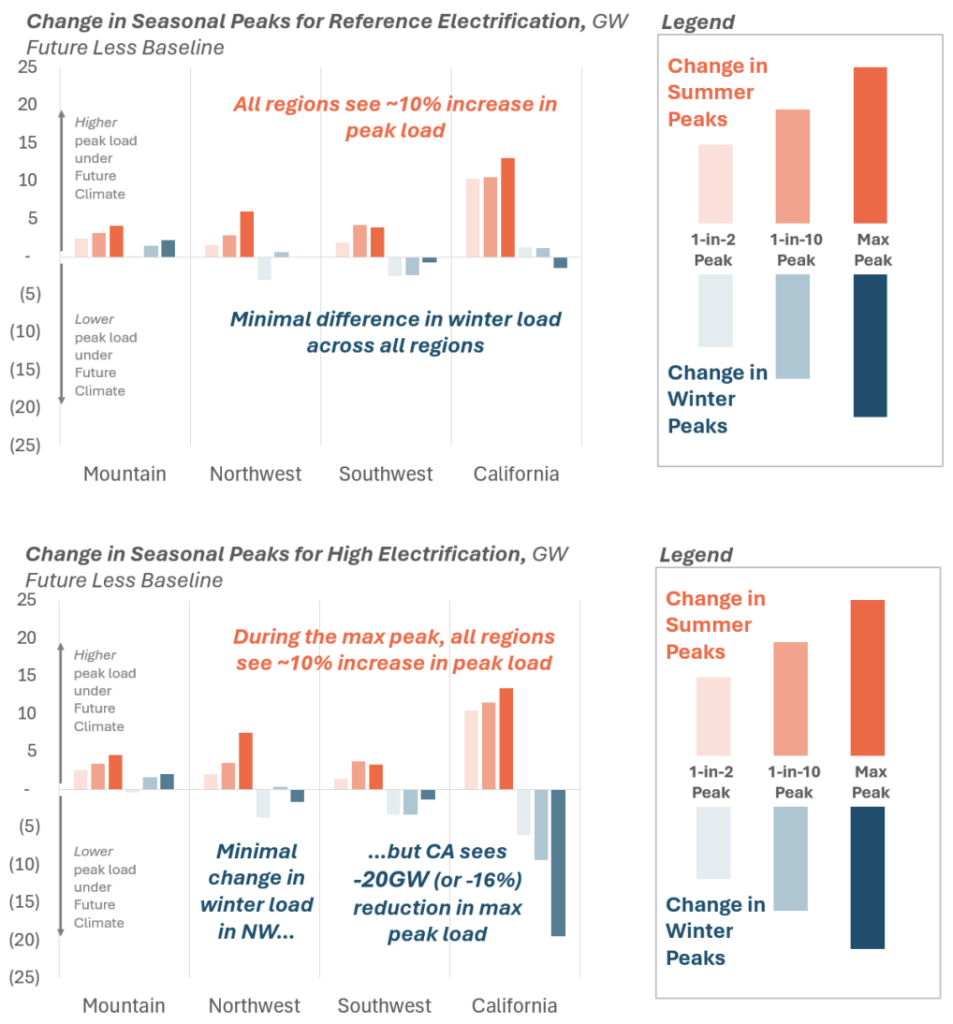
Another silver lining in these results is that most of the new resources that the West is likely to build over the next twenty years, including solar, storage and wind, may not be dramatically impacted by climate change. It is true that hydropower production is expected to decrease due to changing precipitation patterns, but this is a change that the West appears capable of managing. The uncertainty ranges in new resource builds from electrification had a bigger impact on the generation resources selected by our models than the climate data alone.
Earlier studies, done when California and the West relied far more heavily on natural gas and coal, projected that climate change would result in significant new capacity needs. Renewables and storage balanced by hydropower and natural gas, appear more resilient to climate impacts than the gas-dominated generation fleet of a few decades ago.
Climate does matter in the timing and duration of the periods of reliability risk. Under current-policy electrification, California’s summer reliability events are expected to grow longer, some lasting close to a full day, which raised the value of firm capacity and longer-duration storage.
These research results are directional only: they reflect a single global greenhouse gas emissions trajectory and downscaled data from four global climate models. They leave out some climate effects, including wildfire smoke and heat-related losses in power plant and battery performance. The project also showed how much interpretation climate data needs – differences between climate models sometimes exceeded the climate signal itself.
The evaluation of resource adequacy with climate-informed weather data, including impacts to electric loads, hydropower, solar and wind, ensured that the capacity expansion model was not over- or under-building resources to meet demand. This step proved to be an important driver of the final resource portfolios selected in the model. The report calls for further alignment around standardized methods and clear governance over which climate data planners use and how often it is updated, developed jointly by planners and climate scientists. The climate-informed load forecasts and modeling toolkits built for the study are available from the CEC on request.
