


U.S. utilities and system operators are confronting a level of load uncertainty not seen in decades. New demand drivers such as AI data centers, crypto operations, and advanced manufacturing are reshaping both the magnitude and geography of load. These additions often arrive in blocks of several hundred megawatts and can shift, delay, or withdraw faster than traditional planning cycles can accommodate. Historical regression-based approaches built around GDP and population growth were never designed to capture these dynamics.
Utilities are now deploying a wide mix of forecasting methods, and the divergence is growing. Some utilities have introduced probabilistic frameworks that generate multiple load trajectories to test the timing and likelihood of large customer projects. Others include only projects with executed agreements, effectively filtering out early-stage development. At the same time, operating data show that many data centers ultimately consume far less energy than their initial requests or nameplate assumptions. Forecasts that rely on stated demand rather than measured performance can therefore produce systematic overestimates. The practical objective is not to identify a single forecast but to define a credible range of outcomes that supports flexible resource planning and risk management.
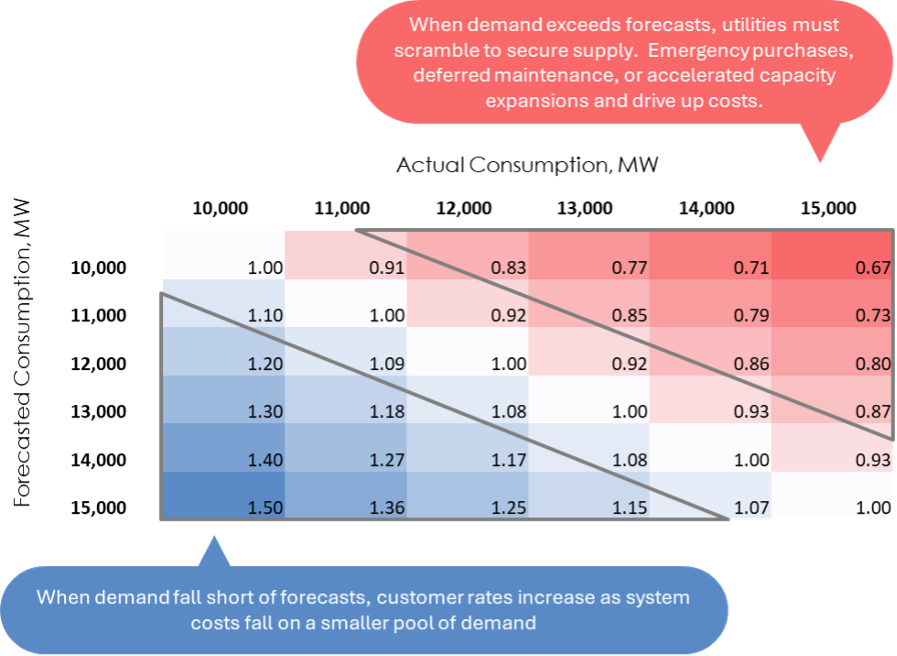
This tension between expectation and reality is not new. In the 1970s, utilities assumed sustained industrial growth and invested heavily in large baseload plants. When demand flattened due to high prices and rising efficiency, customers were left carrying the cost of stranded assets, with long-lasting impacts on trust and rate pressure. Today, assuming that AI-driven load growth will rise indefinitely creates a similar risk. The uncertainty runs in both directions: overforecasting can drive unnecessary capital investment and higher rates, while underforecasting can create reliability constraints and impede economic development. Navigating this uncertainty requires disciplined methods, transparency about assumptions, and planning strategies that remain robust across a wide range of potential futures.
E3’s analysis indicates the sector needs a more consistent framework for forecasting large, uncertain, and fast-moving loads. The new white paper provides a practical structure and set of tools to support that shift. Core insights include:
- The scale and volatility of large load growth are unprecedented, and traditional forecasting methods are not suited to project-driven demand that can appear or evaporate quickly.
- Utility practices today form a fragmented set of methodologies. The absence of shared standards makes it difficult for regulators and planners to compare results, reconcile assumptions, or understand why load expectations can swing by multiple gigawatts from one filing cycle to the next.
- E3’s approach begins with a bottom-up inventory of data centers, then evaluates a range of scenarios that vary project timing, completion risk, and operational characteristics. The intent is to establish a data-driven envelope of possible futures that informs flexible investment, rather than anchoring decisions to a single deterministic forecast.
- Treating forecasting as part of a dynamic system, connected to demand response, rate design, and financial protections, strengthens resilience, reduces exposure for customers, and positions utilities to adjust as technology and market conditions evolve.
For more detail on the methods, scenarios, and planning tools described in the study, you can download the full white paper below. It outlines a practical approach that helps utilities support emerging industries while maintaining reliability and limiting exposure to stranded costs.
Download the paper >
To learn more about E3’s work on data centers and large load forecasting, please contact kushal.patel@ethree.com.
