

The Illinois Commerce Commission (ICC) Staff, supported by E3, has released the Gas Decarbonization Pathways Study, a key milestone in the state’s ongoing Future of Gas proceeding. Launched in March 2024, the proceeding examines how Illinois’ gas system should evolve to meet the state’s long-term climate goals. The Pathways Study supports that effort by analyzing the tradeoffs among different technology and policy approaches to decarbonizing the natural gas sector.
During Phase 2B of the proceeding, Future of Gas stakeholders defined five gas system decarbonization scenarios, which the study evaluates alongside a business-as-usual (BAU) scenario:
- BAU: the path Illinois is currently on, absent any incremental policy measures.
- High Electrification: full electrification of gas end uses.
- High Geothermal: electrification paired with geothermal technologies, including ground-source heat pumps and networked geothermal systems.
- Hybrid Electrification: electrification plus hybrid heating systems that use gas as backup on the coldest days of the year.
- Hybrid Gas: hybrid electrification combined with gas efficiency measures and alternative fuels.
- Continued Gas Use: gas efficiency, gas heat pumps, and alternative fuels.
Each scenario reaches the study’s targets of a 35% reduction in greenhouse gas (GHG) emissions by 2035 and net zero emissions by 2050 on a fuel-cycle basis. Like the scenarios, Future of Gas stakeholders set these targets for the study during Phase 2B of the proceeding; they are not Illinois state targets. The scenarios are compared using a standard set of metrics, including reliability, system infrastructure requirements, costs, environmental justice, and health impacts. The Pathways Study was developed in close consultation with a Pathways Study Working Group made up of utilities, environmental organizations, and industry experts. The group advised on key inputs and assumptions, modeling methodologies, and results.
Key findings from the Gas Decarbonization Pathways Study include:
- Emissions. The scenarios reach the study’s targets through different methods. High Electrification and High Geothermal scenarios achieve the highest direct emissions reductions, while Hybrid Gas and Continued Gas Use rely on higher levels of captured CO2.
- Technology Adoption. Higher electrification scenarios rely more heavily on heat pump adoption, while higher gas scenarios rely more on alternative fuels.In the High Electrification, High Geothermal, and Hybrid Electrification scenarios, annual heat pump sales increase from an estimated 40k in 2025 to 160–180k in 2030 and roughly 300–400k by 2050. In the Hybrid Gas and Continued Gas Use scenarios, combined biomethane and e-methane demand reaches 330 TBtu and 490 TBtu, respectively, by 2050. For comparison, the entire U.S. currently consumes about 180 TBtu of biomethane and biogas.
- Impact on Gas System. All decarbonization scenarios see a transformation of the gas system. By 2050, gas throughput falls 84% from 2025 levels in the High Electrification and High Geothermal scenarios, and 51% in the Continued Gas Use scenario. Higher electrification scenarios also see an 84% reduction in gas customer count. As throughput and customer counts fall, gas rates in these scenarios climb to 25x 2025 levels by 2050. In higher gas scenarios, gas rates rise to 4x 2025 levels by 2050 due to greater reliance on alternative fuels. Under the study’s assumptions, a managed transition, in which customer departures are geographically coordinated to decommission portions of the gas system, does not impact these long-term rate dynamics, because gas throughput reductions occur at a faster rate than reductions in system costs.
- Impact on Electric System. Across all decarbonization scenarios, annual electricity consumption increases 86–121% and peak demand increases 49–130% by 2050, relative to 2025 levels, driven by data center growth common to all scenarios and by electrification. Meeting this growth while transitioning to a lower-carbon supply mix requires substantial investment in generation, transmission, and distribution, increasing total system costs and putting upward pressure on rates. Pairing electrification with geothermal or hybrid heat pump technologies reduces 2050 system peaks by 36–55% relative to scenarios with all air-source heat pumps, lowering peak-driven infrastructure needs and mitigating associated rate pressure.
- Economy-Wide Costs. Total cumulative costs relative to BAU reach $190–350B (net present value, real 2025$) by 2050 across scenarios. Sensitivities on key cost assumptions shift these totals by roughly $110–160B. When climate and health benefits are considered, all scenarios deliver cumulative net benefits.
- Customer Cost Impacts. Under today’s electric and gas rates, switching from gas to electric heating is likely to raise average monthly utility bills for most customer types by up to 36%. Electric home appliances also have higher upfront costs than gas appliances today. By the mid-2040s, customers who remain on the gas system have the highest energy bills in every scenario, reflecting the gas rate increases described in Finding 3.
- Slower Transition Sensitivities. A slower transition sensitivity tested reaching 30% GHG reductions by 2035 and 80% by 2050, rather than 35% and net zero. Under this path, energy system costs and societal benefits are both about 30-40% lower, so total net costs are roughly the same under either target in most scenarios.
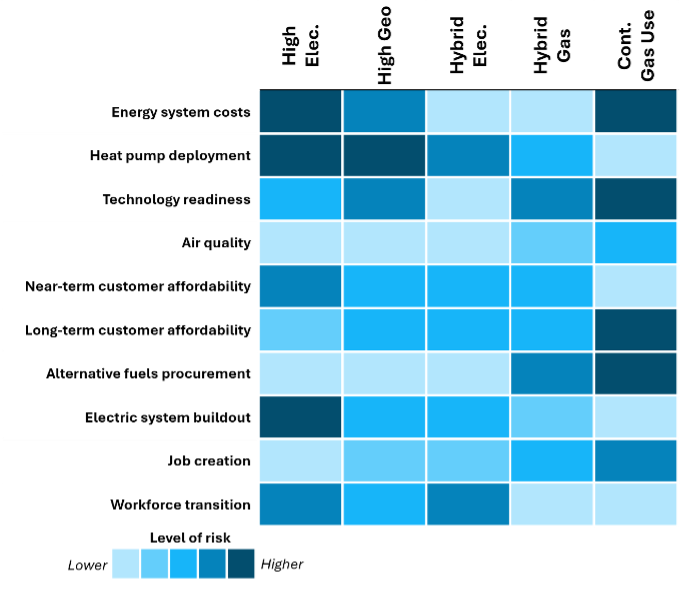
- Risks and Uncertainties. All scenarios require transformation across technology adoption, energy usage, and infrastructure, and each carries different opportunities and risks. Electrification-focused scenarios face greater challenges in near-term affordability, the scale of heat pump deployment, and electric system buildout, but lower challenges in technology readiness, air quality, long-term affordability, and job creation. Higher gas scenarios result in less near-term disruption for customers and greater workforce transferability, but face greater challenges in alternative fuel procurement, technology readiness, long-term affordability, and air quality. Intermediate scenarios, such as the hybrid scenarios and High Geothermal, still carry uncertainties, though to a lesser degree than High Electrification and Continued Gas Use.
Every scenario explored relies on some combination of energy efficiency, building electrification, alternative fuels, and reliable low-carbon electricity. Because these strategies hold up across pathways with very different technology mixes and assumptions, they are good candidates for low-regret, near-term action in Illinois.
The Future of Gas proceeding is expected to conclude in December 2026 with a final report and recommendations from ICC Staff. The Pathways Study report, technical appendices, and modeling inputs and outputs are available at the links below.
