

Electricity affordability has become a central regulatory and legislative concern, and that concern is increasingly focused on the distribution system. Distribution is the fastest-growing part of the utility bill, absorbing new load from vehicle and building electrification and large new customers. Regulators and policymakers are responding by scrutinizing distribution spending closely and looking for lower-cost alternatives to building more infrastructure, especially as interconnection backlogs, permitting, and long equipment lead times slow the conventional grid buildout.
Batteries, flexible loads, and the programs that orchestrate them can defer or avoid those upgrades by reducing load when and where the grid is constrained, and states and utilities are rolling out a growing set of local value of DER (LVDER) programs to pay for that benefit. Whether it actually lowers utility costs, however, depends on program design. A new E3 whitepaper lays out the analytical basis for local distribution value, identifies the design choices that determine whether a program captures it, and proposes a compensation framework that supports a robust DER market while protecting affordability. E3 previously developed the Local Net Benefits Analysis framework used to value distribution deferral for California’s utilities and has applied similar methods in New York, Illinois, and Massachusetts.
Top-down studies point to substantial potential for DER grid services, but bottom-up modeling shows how sensitive that value is to dispatch. PG&E’s 2026 High DER Electrification Impact Study using their LoadSEER and CYME distribution modeling tools found orchestrated flexibility could cut distribution investment through 2040 by about $1.8 billion, roughly 7% of costs, but only when resources responded to local distribution conditions; following bulk-system price signals instead, the savings fell to about $0.15 billion.
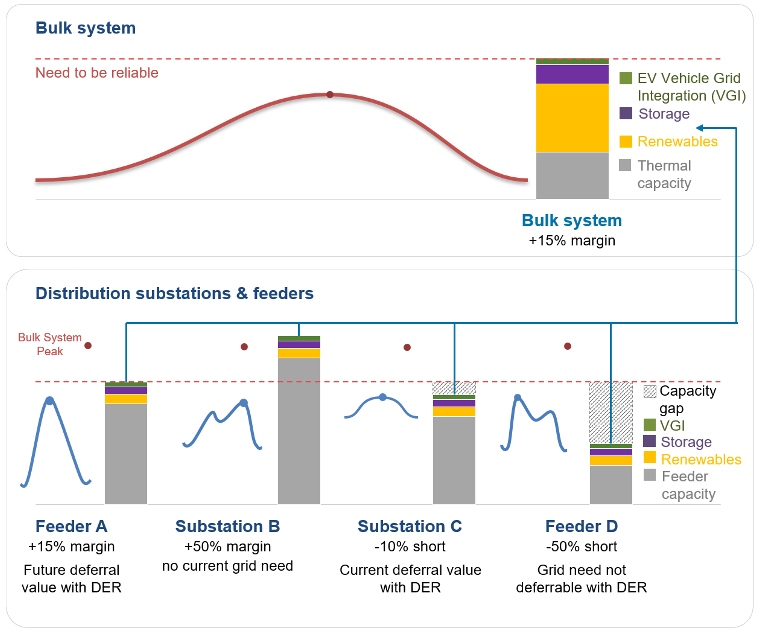
That opportunity is also concentrated in a small slice of the grid: utilities’ grid needs assessments flag only 10-20% of feeders and substations, and only a fraction of those can be deferred by DER. A resource provides distribution value only when it sits on a constrained feeder and reduces load reliably during the hours that drive investment, a much smaller target than bulk-system capacity. Because that value is concentrated in a small subset of the grid, a single system-wide rate overpays the many resources that defer nothing and underpays the few sited where deferral is possible.
The whitepaper holds LVDER compensation to three principles: anchor payment to verified avoided cost and set it modestly below that benchmark, pay for measured performance during the hours that drive distribution investment rather than for enrollment, and consolidate programs onto common, open standards. Its core is a two-tier payment, a modest system-wide credit to every DER for broad load reduction and a targeted locational payment only where a resource can demonstrably defer an identified investment, up to the quantity that relieves it.
The resources enrolling today will still be under contract when the bulk of electrification load arrives, so the rules written now will price distributed capacity for a fleet several times today’s size. Getting the basis right while enrollment is small is far easier than reforming a program after it scales. Compensation built on verified, locational, performance-based value can grow with the DER fleet, steering investment to the feeders and hours where distributed resources actually relieve the grid and turning DER from a driver of rate pressure into a real alternative to capital spending.
Read the full paper >
For further information on E3’s work in distribution planning, please contact eric@ethree.com.
