


Massachusetts is preparing for a widespread shift to electrified vehicles and buildings. As part of its plan to reach net-zero greenhouse gas emissions by 2050, the Commonwealth will need to more than double its electricity demand and add over 50 gigawatts of new renewable generation.1 These changes will fundamentally reshape energy use and the investments needed to maintain a reliable, clean and affordable system. A new draft study prepared by E3 for the Massachusetts Department of Energy Resources (DOER), Evaluating Load Management Strategies for a Net-Zero Grid in Massachusetts, examines how the Commonwealth can manage electricity demand in this evolving energy landscape.
Load management, including shifting, shaping, or reducing electricity use, will be an important strategy for ensuring efficient utilization of existing and new infrastructure by better aligning demand with clean energy supply. Through continued investment in energy efficiency and flexibility, Massachusetts can reduce peak demand, increase renewable energy utilization, and limit the need for new investments in generation, transmission, and distribution.
This study evaluates peak demand reduction potential for specific scenarios, and the potential benefits and costs for load management measures. Evaluated measures include:
- Passive measures: Primarily building efficiency measures, including stretch building codes, cold-climate air source heat pumps, ground source heat pumps, hybrid heat pumps utilizing existing non-electric gas backup, shell retrofits (basic and deep) and stretch building codes for new construction.
- Active measures: demand response for industrial loads, grid-enabled hybrid heat pumps, HVAC flexibility, water heater flexibility, home appliance shift/shed, EV managed charging and V2G, and BTM storage.
One of the study’s findings is that effective load management could substantially reduce the Commonwealth’s future electricity peak demand. E3 developed two technology adoption scenarios – an “Incremental Growth” scenario with modest levels of electrification and flexible technology uptake, and a “CECP 2050 Growth” scenario with higher levels of electrification aligned with the 2050 Climate and Clean Energy Plan (CECP) and higher levels of end use flexibility. Across these scenarios, passive measures can avoid 8-9.5 GW of peak demand by 2050, during the period of greatest system need, as determined by renewable energy availability and demand (i.e., “net peak demand”). Active measures, such as smart EV charging, flexible heating and cooling, and distributed storage, could flatten another 2.3-4.3 GW of net peak demand. Together, these measures could lower gross peak load by nearly 30% in 2050, relative to counterfactual electrified, unmanaged peak without energy efficiency.
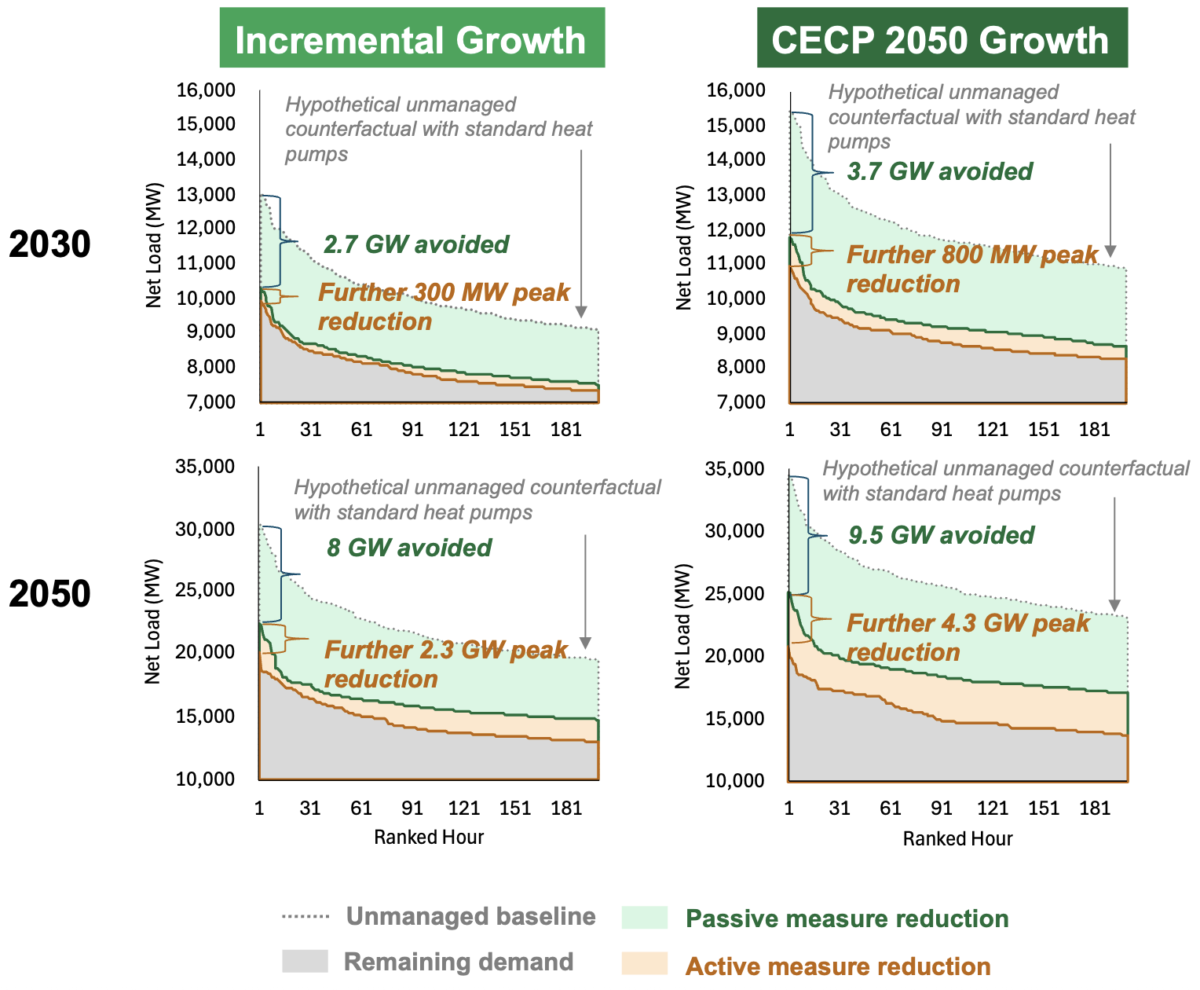
By 2050, when the New England grid is expected to be strongly winter-peaking, E3 estimates that cost-effective load management strategies could avoid between $7 to $9 billion in annual total resource cost (TRC) net benefits. These benefits include avoided electric system costs and emissions and exceed the costs of implementation (such as capital costs). The largest benefits come from efficiency measures such as cold-climate heat pumps (relative to lower efficiency heat pumps) and stretch energy codes for new construction (relative to the state Building Energy Code), along with managed EV charging. Other measures such as deep building retrofits and ground-source heat pumps deliver valuable savings but require substantial upfront investments that lead to net lifetime costs.
As load management strategies are pursued, the study emphasizes that it will be important to keep potential equity impacts central to planning. Disadvantaged communities can enjoy numerous benefits from load management strategies, including avoided outages, enhanced building-level resilience, reduced environmental pollution, increased job creation, and reduced energy burden. The study cautions that poorly designed programs could unintentionally raise costs for customers facing barriers to participation, such as renters or lower-income households, if incentives or rates are not carefully aligned with actual system savings. The analysis includes a social vulnerability index mapping that highlights communities with overlapping socioeconomic and housing vulnerabilities, underscoring the opportunity for program design to consider and prioritize vulnerable communities and customers in creating programs and targeting programs for load management.
As explored in the recently published Grid Services Study, realizing the full potential of load management will require new technologies, evolving policies, and better coordination between utilities, regulators, and customers. The report identifies several key enablers. First, price signals must reflect real-time grid conditions so that customers and devices respond when it matters most. Second, technologies such as virtual power plants (VPPs) and distributed energy resource management systems (DERMS) will be essential to coordinate thousands of devices (heat pumps, EVs, batteries) so they operate together as reliable system resources that can participate in wholesale energy markets. Finally, investments in advanced metering infrastructure and interoperable equipment as well as standardized data-sharing will be critical to unlock widespread participation and ensure grid operators can plan and manage distributed resources effectively.
E3’s analysis concludes that managing when and how electricity is used will be critical to an affordable and complete energy transition. Effective load management can reduce costs and make the transition to a clean energy economy more equitable, but achieving this vision will take concerted action to scale up enabling technologies, reform retail rate structures, and ensure programs reach all communities.
E3’s in-house Excel models, used for this study, are available for download here:
- “Phased” Scenario, Clean Energy and Climate Plan for 2050, Executive Office of Energy and Environmental Affairs, https://www.mass.gov/doc/2050-clean-energy-and-climate-plan/download ↩︎
