

Governor Sherrill of New Jersey has made energy affordability a key part of her policy agenda. In January 2026, she signed Executive Order No. 1, which, in part, directed the New Jersey Board of Public Utilities (NJBPU) to examine electric utility business model modernization and reform options. The NJBPU engaged E3 to support the resulting two-phase study, and the Phase 1 report (authored by E3) was published last week.
The business model is the regulatory framework that determines how the state’s four electric distribution companies recover costs, earn returns, and are incentivized to invest in the grid. New Jersey’s utilities operate under cost-of-service regulation, which has long supported reliable service and access to capital. The Executive Order looks at whether modernizing the framework and pursuing various reform options could better align utility decision-making and incentives with customer affordability outcomes, particularly focused on the long-term bill reduction and stabilization.
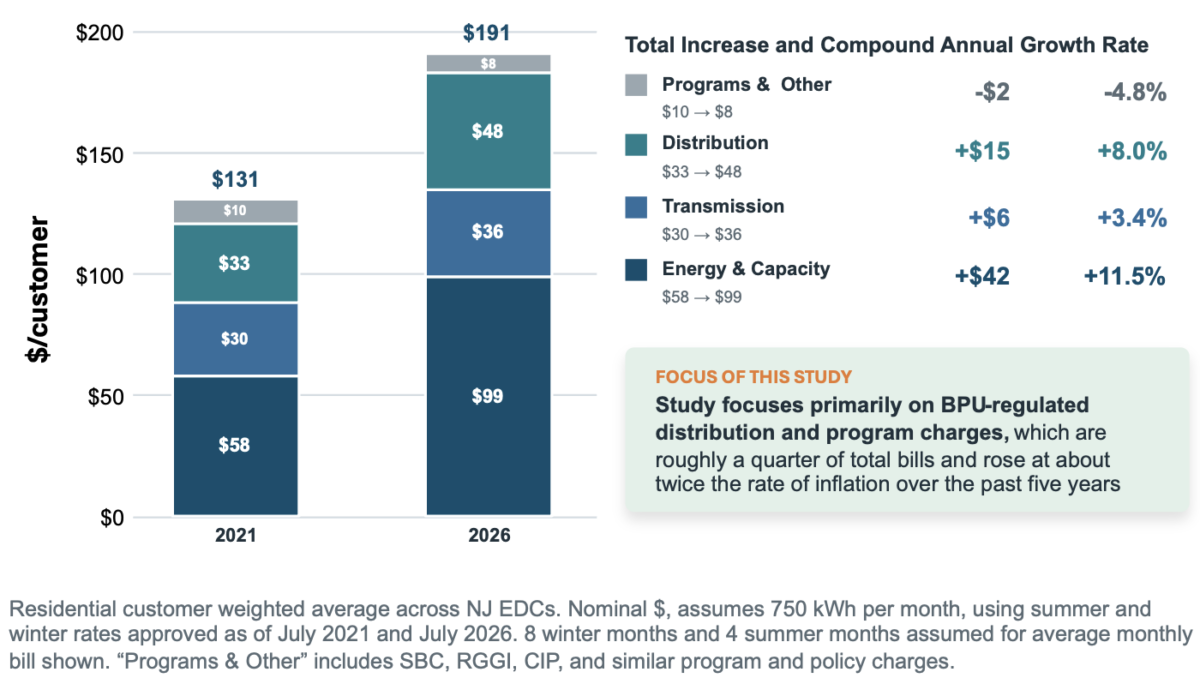
The study examined customer bills and how potential business model reforms could address costs. Distribution charges, the component NJBPU most directly regulates, are about a quarter of the average residential customer’s bill. Supply and transmission make up most of the rest, shaped largely by broader PJM markets, FERC-regulated transmission rates, and wholesale fuel prices, and supply alone drove almost 70% of the bill increase since 2021. The report puts business model reform options in this broader context.
E3 assessed reform options across four approaches:
- Modifying financing and cost recovery
- Aligning utility incentives with cost minimization
- Strengthening regulatory scrutiny of spending
- Improving system utilization
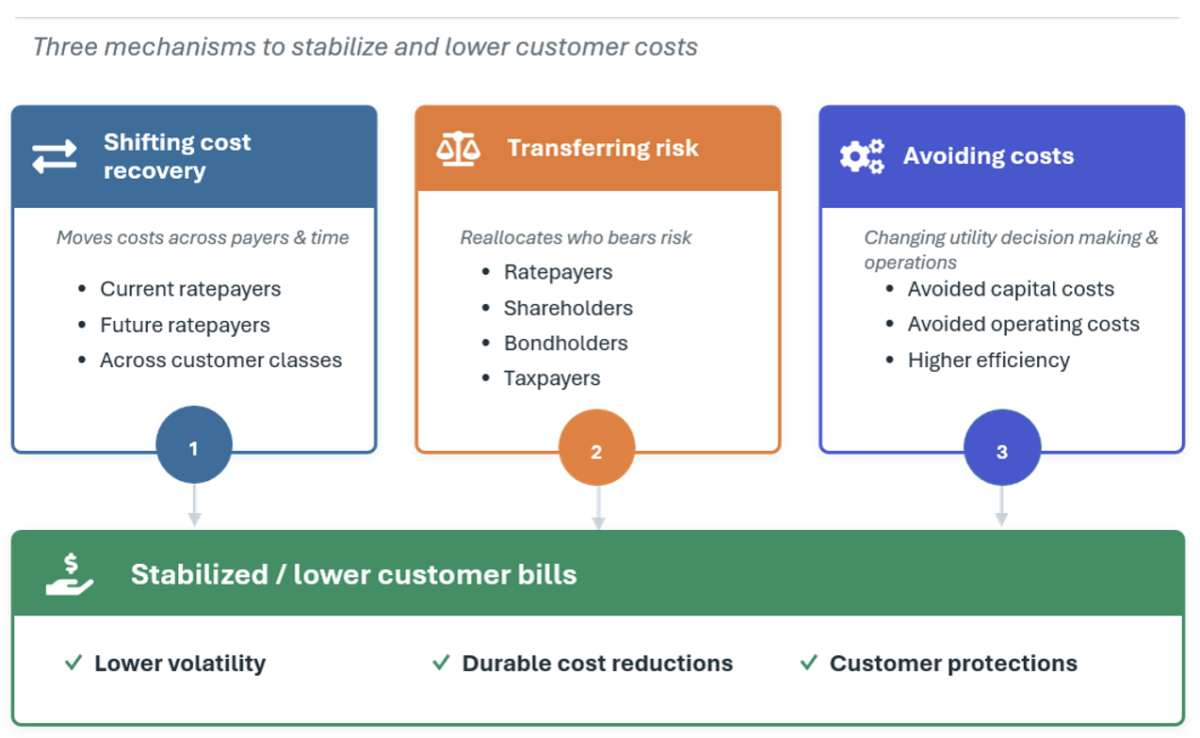
Each option is classified by what it does to costs and potentially to customer bills. Some reforms lower what the system costs, by avoiding capital projects, reducing financing costs, or making better use of the existing grid. Others move costs around without reducing them. Stretching depreciation schedules lowers bills now and raises them later. Securitization refinances costs at lower interest rates without making the underlying costs any smaller. A reform that looks like savings on next year’s bill may be a cost shifted to other customers or to the future, and the report evaluates every option against that test.
Other jurisdictions have tested many of these tools, with mixed results. The same mechanism performs differently across jurisdictions depending on design, data, and regulatory capacity.
The report concludes that no single reform is a standalone solution, and that a portfolio of reforms and supporting policies offers New Jersey the best chance of managing costs. It recommends starting with a set of low-regrets measures that the NJBPU can pursue now, under its existing authority, with little risk of raising bills. These reforms focus on strengthening transparency and oversight of utility capital spending and reviewing how and when costs are recovered from customers. On their own these steps may produce only modest savings, but they slow unnecessary cost growth and build the baselines, metrics, and data New Jersey would need before taking on more ambitious reforms. Multi-year rate plans and broader performance-based ratemaking could come later, once those foundations are in place.
Phase 1 drew on two public stakeholder sessions and 56 written comments, and provides a higher-level foundation for a quantitative deep dive in Phase 2. That work, expected to take place over the remainder of 2026, will include more detailed analysis of individual options and reform packages, modeling candidate reform pathways to estimate bill impacts, customer class effects, and utility financial outcomes. The results will support a more informed roadmap for the NJBPU’s consideration, aimed at long-term bill reduction, bill stabilization, transparency, accountability, and customer value.
Read the full report here >
To learn more about E3’s work on utility regulation and business model reform, contact kushal.patel@ethree.com and liz.mettetal@ethree.com.
