

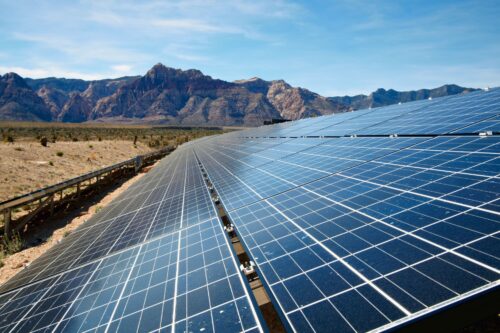
The Desert Southwest is in the middle of a generational transformation of its electricity system. Utilities expect peak demand across the region to grow by at least 30% over the next decade, driven largely by data centers and other large industrial customers, while a sizable share of the region’s aging capacity is set to retire. In 2022, E3 published a study on resource adequacy in the southwest on behalf of six regional utilities, quantifying the resources needed to maintain reliability under that growth trajectory. Four years later, the same group of utilities – Arizona Public Service (APS), Arizona Electric Power Cooperative (AEPCO), El Paso Electric (EPE), Public Service Company of New Mexico (PNM), Salt River Project (SRP), and Tucson Electric Power (TEP) – commissioned E3 to revisit the question with updated data and a wider lens, extending the analysis from a decade to a 20-year horizon.
E3 held a webinar with study authors Nick Schlag and Adrian Au, with an introduction from Ron Klawitter of Salt River Project, to present the study findings. Please find the recording below, and slides can be found here.
The analysis is structured in two parts: a near-term assessment provides an updated projection of the region’s resource adequacy position through 2035, and a long-term assessment exploring the features of resource portfolios capable of meeting adequacy needs through 2045 across a range of load forecasts, availability technologies, and clean energy futures.
Phase 1: Near-Term Reliability
The near-term assessment uses E3’s RECAP model to evaluate the region’s load-resource balance against a 1-day-in-10-year loss of load expectation. Aggregating utility forecasts and resource plans (as of Q1 2025), E3 finds that load growth and retirements create a need for roughly 18 GW of new effective capacity by 2035. Utilities’ plans, which include 40 GW of new natural gas, solar, wind, and energy storage installed capacity, are sufficient to close that gap.
The changing resource mix is causing major shifts to the timing of reliability risks. As the region brings more solar, wind, and storage, the timing of risk shifts away from the traditional afternoon peak. Those shifts change the marginal capacity value of resources whose availability is misaligned with the region’s evolving critical periods. Today’s risk is concentrated in the evening net peak, when demand stays high after solar drops off. Modeling shows risk extending into the overnight period by the late 2020s, and stretching from roughly 7pm to 7am by 2035.
Phase 2: Long-Term Portfolio Optimization
To assess regional resource adequacy needs beyond 2035, E3 constructed and evaluated 23 hypothetical portfolios using long-term capacity expansion modeling in PLEXOS LT, spanning three load forecasts, two technology sets (commercially available today, and a broader set that includes long-duration storage, advanced geothermal, and small modular reactors), and clean energy penetrations from 60 to 95%. The portfolios are carefully calibrated to meet regional resource adequacy needs through 2045, allowing the study to highlight common features of resource mixes capable of maintaining regional reliability under different futures:
- All portfolios studied include a diverse mix of firm, renewable, and energy-limited resources – each of which contributes to resource adequacy in a different way.
- All portfolios have enough firm resources – resources able to operate at full capacity for as long as needed – to meet at least 45% of system peak demand. These resources provide the backstop capability needed to ensure reliability during overnight periods once storage has been depleted and during multi-day periods of low renewable output.
- All portfolios rely on natural gas as the primary option to satisfy the need for firm resources. Even at the highest penetrations of clean energy studied (95%), the total installed capacity of natural gas resources across the region is roughly 40% of peak demand.
- The total amount of new installed capacity in all portfolios will require resource additions at a pace that is unprecedented for the region. Total installed capacity additions between 2025 and 2045 range from 50-140 GW depending on load and clean energy assumptions
Both the 2022 and 2026 assessments conclude that the region’s utilities have the analytical tools and planning frameworks needed to identify resource portfolios capable of maintaining reliability. The remaining challenge is execution. Translating plans into operating resources at the pace required will depend on coordination across procurement processes, interconnection and permitting processes, transmission planning and development, natural gas transportation infrastructure, and large-customer load management, none of which any single entity controls. The study identifies six implementation risk factors and corresponding strategies for utilities and regional stakeholders to focus on, recognizing that even well-formulated plans will require continuous reevaluation in a planning environment defined by uncertainty and rapid change.
Read the full report >
To learn more about E3’s work on resource adequacy in the Desert Southwest, please contact nick@ethree.com.
