

REMATCH is E3’s load-matching tool designed to help large commercial and industrial electricity developers and consumers, like data centers, identify and compare the costs and emissions associated with different potential resource portfolios at the customer level. The model leverages multiple data streams from E3’s Market Price Forecasts – including hourly day-ahead energy prices, localized generation profiles for solar and wind assets, and regional marginal emission rates – along with applicable utility tariff rates to determine the optimal resource mix and portfolio size to support any load user’s particular operational profile and emission reduction goals.
Specifically, REMATCH can help large load users evaluate:
- The necessary procurement volume of zero-carbon generating capacity and/or battery energy storage (BESS) needed to achieve emissions-reduction targets, relative to the relevant regional baseline;
- The net cost of procuring those resources at a regional level over a planning horizon of up to 30 years, including cross-regional comparisons to inform holistic site selection and development strategies; and
- The optimal operations strategy to balance generation variability with load uptime requirements and ramping constraints, considering the availability of incentives, demand response payments from market operators, and the load user’s preferred emissions tracking methodology (e.g. 24×7 hourly matching, annual REC offsets, etc.).
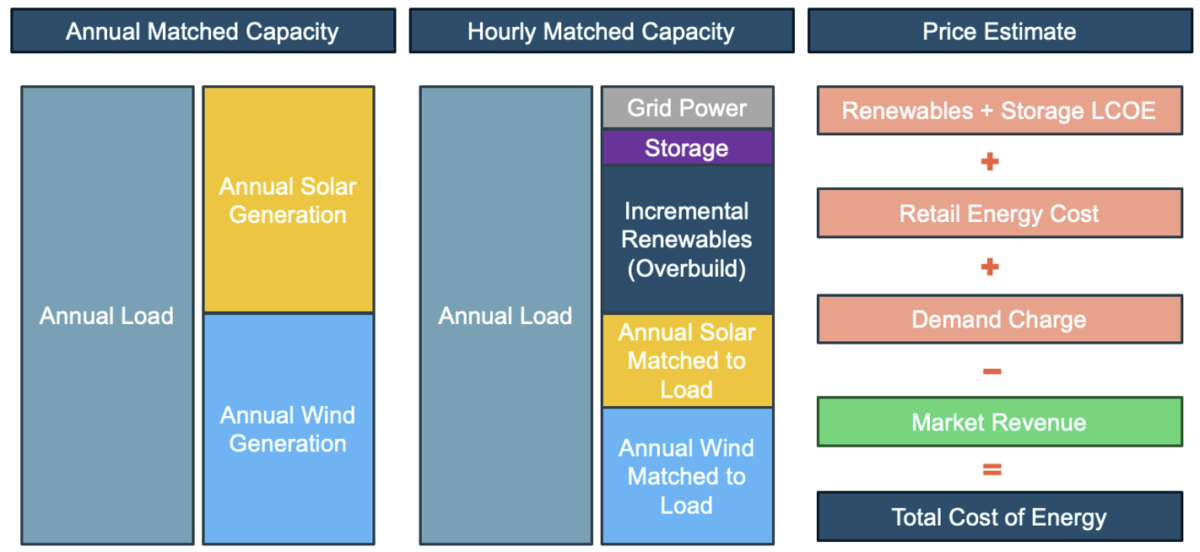
Below is an indicative summary of typical REMATCH inputs, calculation steps, and outputs:
Use cases for REMATCH include, but are not limited to:
- Site screening analysis: Evaluate the relative cost of renewable energy portfolios across different sites by assessing differences in capital costs, capacity factors, and projected wholesale and retail energy prices.
- Portfolio optimization: Identify the least-cost portfolio of renewables and storage to achieve a particular emissions or uptime target
- Levelized cost forecasting: Estimate the net levelized cost of energy (LCOE) for a given portfolio, accounting for sales of excess solar or wind generation. REMATCH can also forecast the levelized cost of associated industrial products, such as green hydrogen or ammonia, by incorporating plant capital and operating costs and any applicable tax credits or incentives.
Who this is for:
- Data center developers
- Manufacturing facilities
- Green hydrogen or green ammonia producers
- Other large energy users
- Generation developers or asset owners
Recent examples:
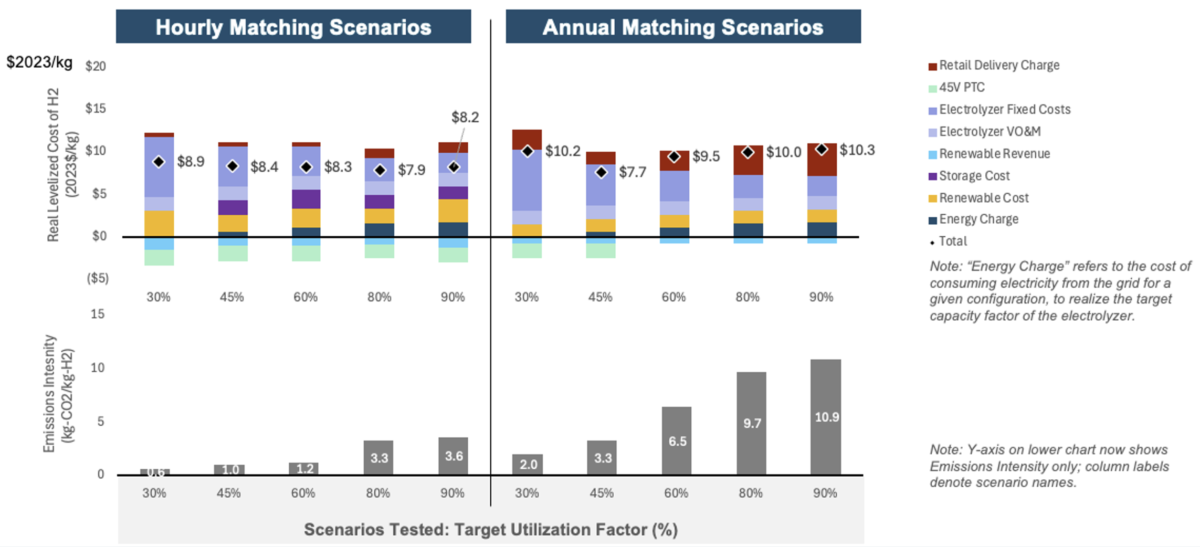
- A hydrogen feasibility analysis for the California Air Resources Board (2025), evaluating the project-level economics and emissions impacts under annual and hourly matching of different electrolytic hydrogen production options
- A study on offshore wind market opportunities for Net Zero Atlantic (2025) evaluating the levelized cost of hydrogen produced through excess offshore wind output
- A dispatch optimization analysis for a confidential WECC asset manager evaluating generation and storage opportunities at a single point of interconnection (2024)
- A cost analysis for a confidential SPP industrial load seeking to understand how different generation offtake configurations could support its federal tax credit qualification strategy (2024)
- A feasibility study and LCOE analysis for a confidential ERCOT and MISO developer comparing potential locations for a large industrial facility (2023)
- A hydrogen emissions accounting analysis for the American Council on Renewable Energy (2023), comparing annual versus hourly clean-energy matching under the IRA’s 45V hydrogen tax credit
All Tools
