


Rapid load growth, an aging power grid, accelerating clean energy targets, affordability pressures, and new federal planning requirements are leading utilities, regulators, and system operators to expand and enhance the processes that shape how transmission is planned, permitted, and operated. E3’s transmission work in 2025 focused on addressing these key challenges facing the industry to support the identification of actionable, cost-effective transmission system needs that are robust to multiple sources of uncertainty. Specifically, E3 supported clients in:
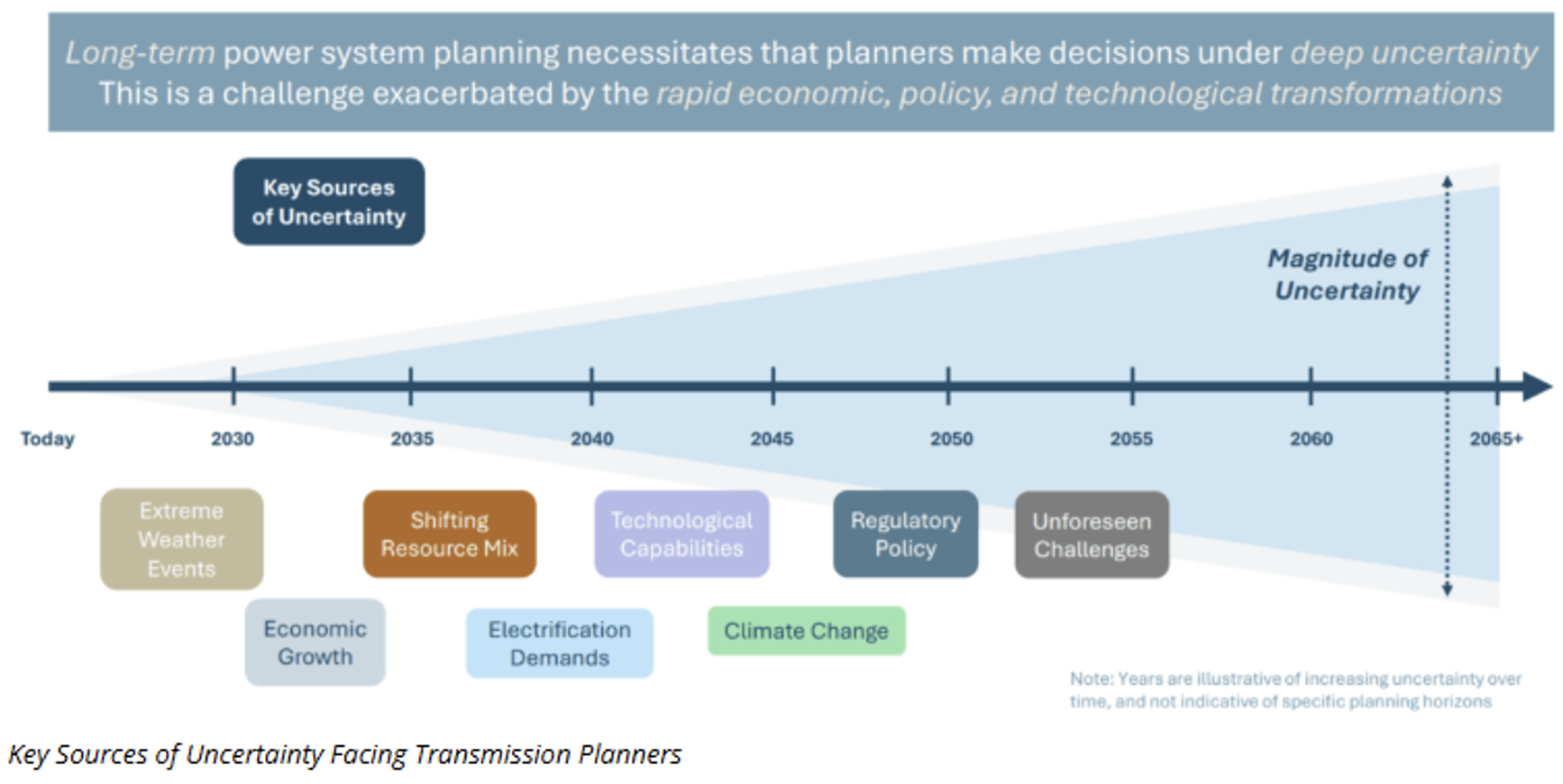
- Enhancing transmission planning frameworks to better account for key sources of long-term uncertainty, including the impacts of data centers, electrification-driven load growth, and changing market and policy conditions;
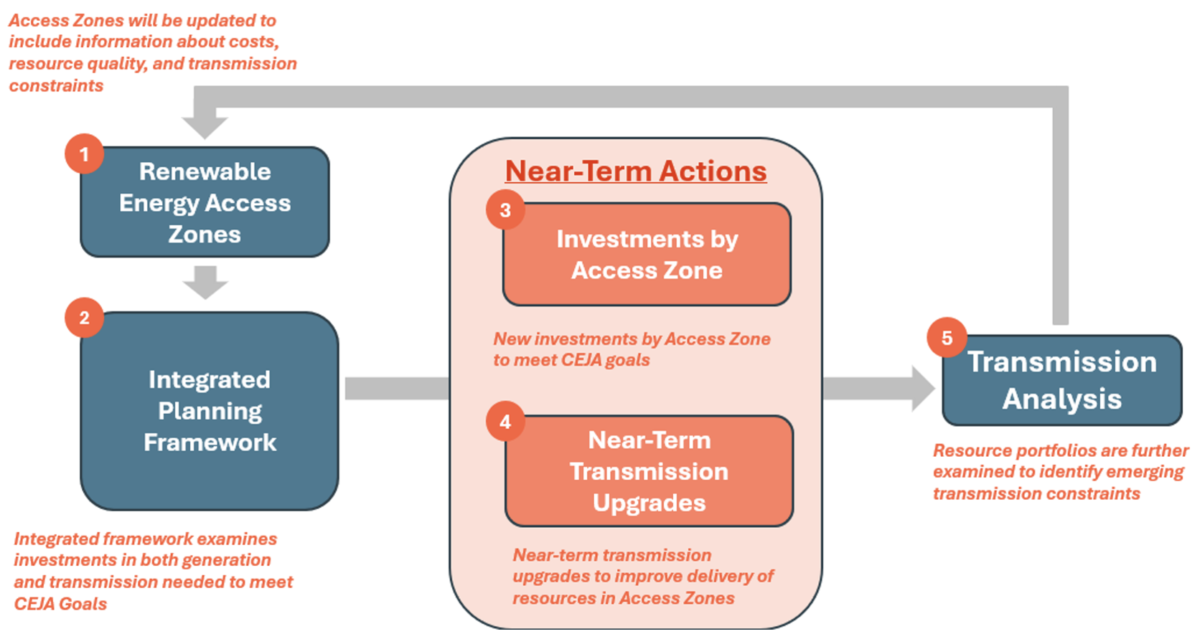
- Coordinating generation and transmission planning into an integrated framework, rather than treating them as siloed;
- Expanding evaluation methods to examine a wider range of solutions including advanced transmission technologies and non-wires alternatives;
- Developing utility corporate strategies to balance long-term system needs with near-term investment and organizational decisions;
- Providing support for competitive transmission bid development; and
- Identifying existing and emerging regulatory pathways that can be most effective in translating identified needs into real projects based on key timing and cost recovery considerations.
Together, these efforts reflect a continued shift towards designing practical pathways for the development of transmission infrastructure.
Enhancing Transmission Planning Frameworks to Address Heightened Uncertainty
Transmission planners across the country are grappling with how to conduct complex transmission planning processes while addressing heightened uncertainty facing the electricity sector. On behalf of the Midcontinent Independent System Operator (MISO), E3 published a whitepaper that reviews and discusses analytical techniques such as adoption of probabilistic methods that can address increasing complexity and help ensure a reliable, clean grid of the future. The study provides insight into emerging methods that capture a wide range of uncertainty – including but not limited to economic and policy changes as well as weather, climate change, correlated outage risks and system contingencies – while ensuring planners maintain a cost-effective and reliable electric system.
In New York, in collaboration with GE Vernova, E3 developed an extensive report reviewing key reliability metrics for the state’s generation, transmission, and distribution infrastructure, coming at a critically important time for the state as it faces increased reliability risks over the coming decade. This report documents key processes and methodologies used to examine system reliability today, emerging issues and key risk factors that are likely to impact system reliability in the future, and how the state can continue to adapt its planning processes to reflect these emerging risks.
In addition to examining emerging analytical methods to address key sources of uncertainty within an individual modeling framework, our work with MISO, New York, and others has consistently highlighted the value of enhancing the coordination between planning frameworks. There are inherent tradeoffs with integrating additional complexity to capture linkages between modeling frameworks; balancing these tradeoffs and capturing the most critical interactions to ensure a cost-effective and reliable system are the subject of Integrated System Planning, described in more detail below.
Integrating Generation and Transmission Planning
E3 is at the forefront of industry efforts to conduct proactive, coordinated generation and transmission planning. A capstone of E3’s transmission work in 2025 was supporting the Draft Renewable Energy Access Plan (REAP) in Illinois, which broke new ground by introducing an actionable, statewide planning framework to examine portfolios of generation and transmission investments. The framework co-optimizes generation and transmission investments to identify least-cost, reliable pathways for meeting Illinois’ clean energy targets under the Climate and Equitable Jobs Act.
E3’s work on offshore wind in Atlantic Canada further highlighted how generation development decisions are inseparable from key questions around interconnection and regional transmission coordination. The study emphasized that proactive and coordinated generation and transmission planning will be required to realize the full potential of offshore wind in the region.
Expanding Evaluation Methods to Examine a Wide Range of Solutions
The clean, reliable grid of the future will require a wide range of solutions to modernize and expand the transmission system at the necessary pace and scale. The transmission industry continues to make advancements in extending evaluation frameworks to consider a wide range of solutions beyond conventional transmission upgrades.
In Maine, E3 evaluated a range of grid-enhancing technologies (GETs), including dynamic line ratings, advanced conductors, power-flow control devices, and topology optimization. The analysis assessed the potential for deployment of GETs in Maine using a cost-effectiveness lens, identifying where they could meaningfully defer, downsize, or complement conventional upgrades. The results reinforced that when applied in the right locations and aligned with system needs, GETs can deliver real near-term capacity, congestion relief, and customer savings, often on timelines far shorter than new transmission construction.
The Draft REAP in Illinois also expands the consideration of advanced transmission technologies and non-wires alternatives, establishing a practical and robust avoided-cost framework to evaluate when these tools can complement or defer conventional upgrades.
Corporate Strategy and Competitive Bid Development
In 2025, E3 also expanded its transmission-related work to more directly support utility corporate strategy and investment planning. E3 advised utility clients as they navigated competing capital priorities across reliability, asset health, and system growth, and as they considered organizational and process changes to improve efficiency and execution. This work drew on E3’s sector-specific expertise to provide corporate strategy support grounded in a clear understanding of how technical system needs, regulatory requirements, and financial constraints interact in practice, helping utilities align long-term system needs with near-term investment and organizational decisions.
E3 also expanded its support for competitive transmission bid development, helping clients prepare and evaluate bids by navigating bid design, cost recovery considerations, and risk allocation under evolving regulatory frameworks. This work leveraged E3’s rigorous financial analysis to assess tradeoffs between cost containment and financial risk, allowing clients to position bids that balanced competitiveness with long-term durability.
Identifying Emerging and Existing Regulatory Pathways to Develop New Infrastructure
In 2025, E3’s transmission practice also increasingly focused on implementation pathways to facilitate the development of new generation and transmission infrastructure. In Illinois, the Draft REAP places strong emphasis on how identified transmission needs can lead to the solicitation and development of solutions. It maps identified needs to regulatory pathways including reliability planning, economic planning, long-term planning under FERC Order 1920, state-initiated approaches, and local “right-sizing” opportunities. In California, E3’s work with the Governor’s Office of Business and Economic Development (GO-Biz) also identified opportunities to streamline local siting and permitting processes that are often a bottleneck to clean energy infrastructure development.
E3 further supported transmission developers, utilities, and regional stakeholders as they addressed complex questions around cost allocation, emerging market structures, and new federal planning requirements. This included the development of practical frameworks to surface the tradeoffs inherent in different cost allocation approaches, helping stakeholders move beyond conceptual questions toward key decision-making criteria. E3 also supported developers in designing new potential market products that could reflect additional benefits of transmission investments. In parallel, E3 worked with regions and stakeholders across the country as they considered the practical implementation of FERC Order 1920, including the mechanics of benefit calculations and how methodological choices can influence planning outcomes and investment signals.
Looking Ahead
By building on the momentum of recent years, E3 believes the industry will be well-positioned to identify actionable transmission system needs that are robust to a wide range of plausible futures. E3 looks forward to continuing to provide support to our diverse mix of clients across the transmission landscape as they work to strengthen our transmission infrastructure at the pace and scale necessary to meet growing demand reliably and affordably, improve system resilience, and facilitate continued clean energy growth.
To learn more about E3’s transmission work, contact lakshmi@ethree.com.
