


Electric vehicles are a large and growing source of flexible load. A managed EV can shift its charging to low-cost hours. A V2G-enabled one can go further, sending power back to the grid during the highest-value hours for reliability and congestion relief. E3’s latest work for GM Energy quantifies the benefits of that flexibility and explores how customers and utilities can capture it.
GM Energy engaged E3 to value EV load management (V1G) and vehicle-to-grid (V2G) charging across U.S. electricity markets. The study spans two projects: a national assessment of the grid and customer value of V1G and V2G, and how that value changes when an EV is paired with rooftop solar and home storage.
A $7 billion national opportunity by 2030
E3 estimates the national potential annual market value of vehicle-grid integration will reach roughly $7B in 2030. A managed EV is worth a few hundred dollars a year to the grid, but a V2G-enabled one can be worth several times that, because it can discharge during the highest-value hours, not just shift its charging to cheaper hours. A V2G-capable EV, then, provides nearly as much grid value as a dedicated home battery despite being disconnected from the grid while it is being driven. With V2G, an EV can provide significant grid value from an asset customers have already purchased to meet their driving needs, without a separate investment in a home battery. EVs also bring scale – already, GM has a quarter-million V2G-capable EVs on the road in the U.S.
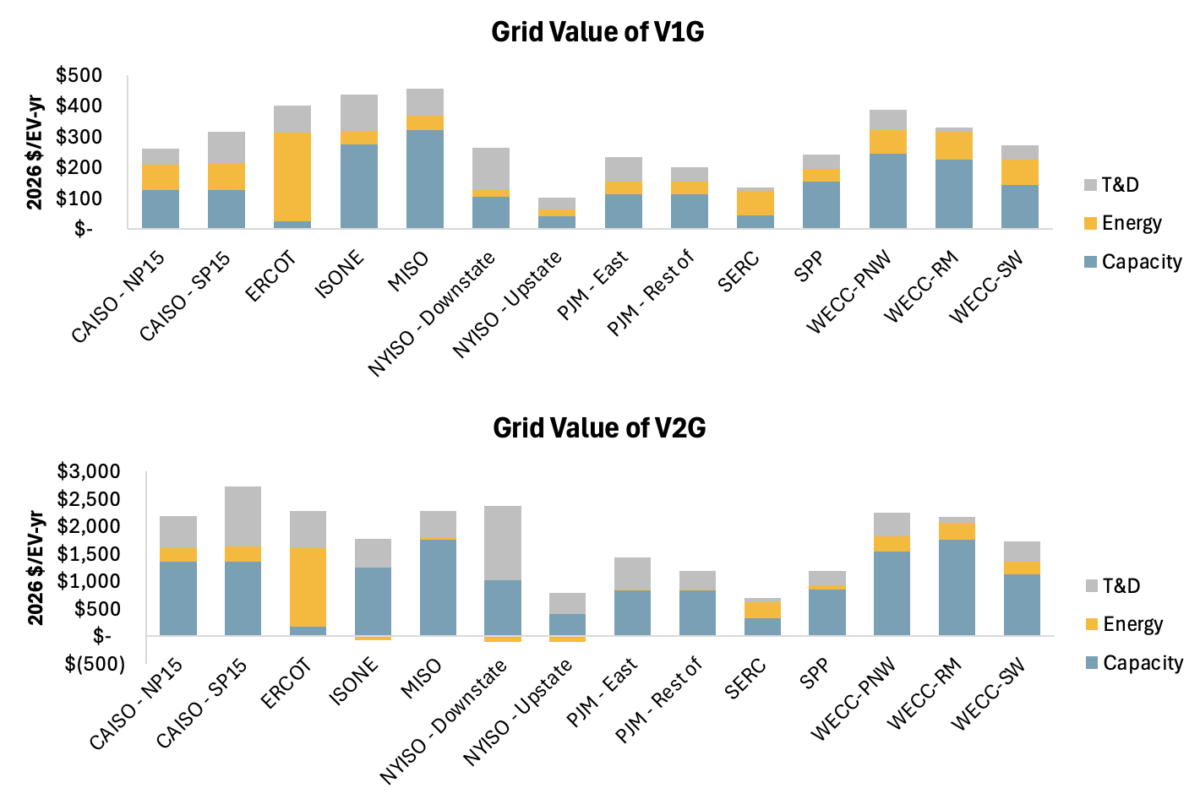
Regions correspond to the U.S. wholesale electricity markets: CAISO (California), ERCOT (Texas), ISONE (New England), MISO (Midwest), NYISO (New York), PJM (Mid-Atlantic), SERC (Southeast), SPP (Central Plains), and WECC (Western states outside California, here split into the Pacific Northwest, Rocky Mountain, and Southwest subregions).
These estimates come out of RESHAPE-EV, E3’s in-house model for simulating how EVs charge. The model builds realistic charging patterns from the driving behavior of thousands of individual drivers, accounting for who has access to home charging, what kind of vehicle they drive, and what it costs to charge in different places and at different times. That produces a separate charging profile for each strategy, from unmanaged charging through V2G, while making sure every vehicle still meets its driver’s real travel needs. The study used E3’s 2030 market price forecasts for each region, then combined the per-vehicle value with a regional EV adoption forecast to scale the results up to a national market.
Most of the grid value is challenging for customers to access
Energy arbitrage, shifting charging to cheap hours and selling back during expensive ones, has historically been a large component of the grid value batteries can provide. By 2030, as stationary battery deployments grow and energy price spreads narrow, most of the value EV batteries can provide comes from capacity-related benefits and transmission and distribution system value, which V2G-enabled vehicles are well suited to provide. Today that value is captured mostly through pilot programs, and there is real opportunity in building these out into programs that pay for EV discharge and reflect what flexibility is worth to the grid.
E3 modeled residential bills at three utilities for an illustrative customer, using each one’s current rates and V2G pilot programs. Managed charging reliably lowered bills at all three. V2G results varied. In E3’s illustrative utility cases, compensation at wholesale energy prices yielded returns too small to meaningfully affect customer bills. Compensation at full retail rates includes fixed distribution, transmission, and policy charges avoided by the customer but not the utility, resulting in a cost-shift to all ratepayers. A compensation structure tied to the actual grid value of the export, with that value shared between the customer and the utility, avoids both problems: customers come out ahead, and the design scales as participation grows.
Whether that value can be earned also depends a lot on how a region runs its electricity market. Regions like the Midwest, downstate New York, and the eastern PJM region have capacity markets that compensate resources for maintaining availability to support reliability during peak system conditions. California relies on a Resource Adequacy framework that serves a similar reliability function. These market structures can create some of the strongest value opportunities for V2G resources. EVs in Texas can provide high grid value, but potential revenues from its energy-only market vary from year to year. EVs in many Southeastern utility territories show lower monetizable value on average because compensation depends largely on utility-specific programs rather than organized wholesale market mechanisms.
The opportunity is large and increasingly within reach. EVs are a flexible grid resource that customers have already purchased to meet driving needs, so capturing their full value depends mainly on program design: new rules, standardized ways to aggregate vehicles, and programs that let customers and utilities share in the value V2G-enabled vehicles create.
Read the full report here >
For further information on E3’s work in vehicle-grid integration, please contact eric@ethree.com.
