

Rising electricity demand, particularly from data centers, has generated widespread attention, with many headlines linking load growth to rising retail rates. These stories often lack important context: electricity rates reflect a combination of system-wide investment needs, regulatory decisions, and cost allocation frameworks. New large loads do not inherently raise costs for other customers (see E3’s recent study on this topic here), but that does not mean they are without potential impacts. Those impacts, however, specifically depend on how they are integrated into the local system over time and how retail rates and tariffs are structured to allocate costs to difference customer classes.
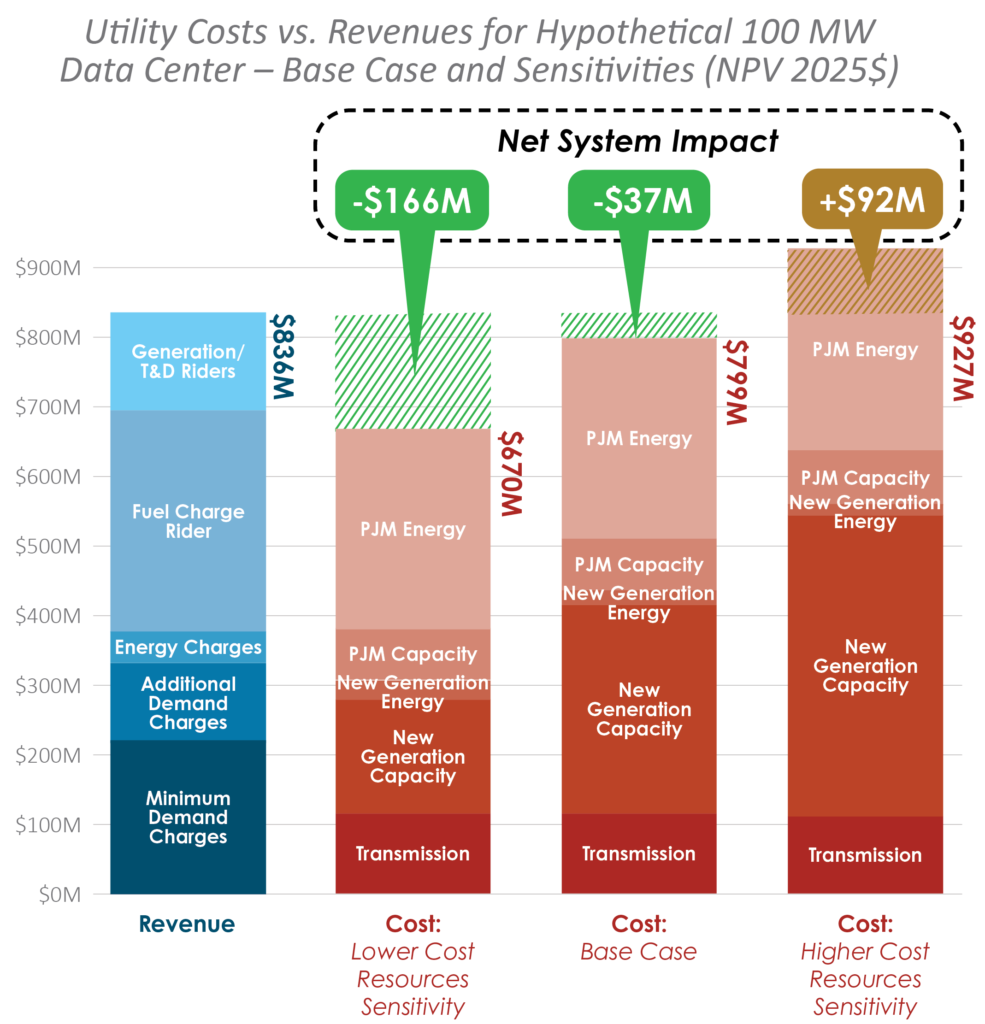
A growing number of utilities have introduced dedicated large-load tariffs to reduce cost-shifting risk and better align cost responsibility. Twenty-five utilities across 19 states have approved data center-specific tariffs, with 18 approved in 2024-2025, and many more under review. These tariffs increasingly incorporate best practices, such as minimum demand charges, long-term contracts, and collateral requirements. One major analytical gap that this paper is looking to fill is to better and more transparently quantify how well these best practices perform from a risk mitigation perspective. This paper specifically quantifies this using a hypothetical 100 MW data center example on Dominion Energy Virginia’s GS-5 tariff as a case study in ratepayer protections.
The full Excel-based model that underpins our analysis and quantification is available for download. The model is intended to support transparency as a public resource for those who wish to explore the underlying assumptions and test alternative scenarios.
Download the full paper to explore the findings >
Download the full model here >
Please note: this model was developed for a specific study and may not be appropriate for other uses without modification. Users should not represent modified model outputs as E3’s work. Inputs reflect the best available data at a point in time and will change; users should verify and update assumptions before relying on results.
1. A System Already in Transition
It’s important to situate data center growth within its broader context. The electric grid is already undergoing a significant investment cycle driven by aging infrastructure, electrification, domestic manufacturing, and resilience needs. Many of these investment needs are arising independent of new large loads and reflect broader system trends already underway. As a result, data center growth is occurring within a grid that is already evolving and reinvesting, rather than being the sole driver of current investment activity.
2. Load Growth, Utilization, and Cost Outcomes Depend on System Conditions and Rate Design
Under the right conditions, large loads can improve system economics. Data centers typically operate at 80-90% utilization, compared to 30-40% for residential customers. Higher utilization allows fixed system costs to be spread over more kilowatt-hours, which can reduce average costs per unit of energy.
The extent of these effects depends on system conditions and rate design. Load growth can reduce average costs when it increases utilization without requiring significant new investment. Where additional infrastructure is needed, outcomes depend on whether incremental revenues exceed incremental costs. With appropriate improvements and innovations to rate design and cost allocation, large loads can help mitigate upward cost pressures.
3. Best Practices in Modern Tariff Design Can Align Cost Responsibility and Protect Ratepayers
The impact of large new loads on other customers depends largely on how costs and risks are allocated through tariff design (or other risk mitigation mechanisms). Dominion Energy Virginia’s GS-5 tariff represents an example of a modern large-load tariff design that employs many of the best practices being considered and adopted across the industry. Our analysis of a hypothetical 100 MW data center under GS-5 shows that in most modeled scenarios, revenues from the load exceed the cost to serve it, meaning the customer covers its full cost of service and can contribute to broader system cost recovery. The tariff’s safeguards, such as upfront collateral and exit fees, are also designed to ensure costs are recovered even if a data center customer delays payment or does not materialize as expected. Our modeled results show that these protections can significantly reduce stranded cost risk and limit cost exposure to other ratepayers.
4. Implications for the Energy Transition and Resource Mix
Data centers are becoming significant drivers of energy investment. They can support the development of renewable energy and emerging clean firm resources such as advanced nuclear and geothermal, and accelerate deployment of wind, solar, storage, and transmission infrastructure. However, rapid load growth can create pressure to maintain or expand other forms of generation, including natural gas, to ensure reliability. The net impact on emissions and decarbonization depends on how these loads are integrated through planning, procurement, and policy. This reinforces the importance of thoughtful system design.
5. The Value of Grid Integration
How data centers connect to the grid also shapes the outcome. Fully integrated facilities can act as anchor tenants, supporting infrastructure investments that benefit the broader system. Upgrades funded to serve these loads, such as transmission and substation improvements, can enhance reliability and resilience for other customers.
By contrast, isolated or off-grid approaches limit these shared benefits. Integration enables large loads to contribute not only financially but also structurally.
The full Excel model is available for download and use here >
The full paper is available for download here >
A one-page overview is available for download here >
To learn more about E3’s work with large loads, please contact kushal.patel@ethree.com.
