

In the past year, E3 has been studying the current and future resource adequacy (RA) situation in the Pacific Northwest region on behalf of a large consortium of utilities and independent power producers. The study examines means for maintaining reliability and affordability for Northwest electricity consumers while meeting both state mandated and voluntary clean energy goals. Topics addressed include anticipated future load growth, generator retirements, clean energy policies, and transmission constraints across the Greater Northwest Region encompassing Washington, Oregon, Idaho, and parts of Montana, Wyoming, and Utah.
Join us for a webinar on April 15, 1pm PT with the study authors to explore the findings in more detail and discuss what they mean for reliability and planning in the Pacific Northwest. Register >
The analysis is structured in two parts: a near-term assessment focused on reliability risks over the next decade, and a longer-term analysis examining resource investment pathways to meet both reliability and clean energy goals.
Phase 1: Near-Term Reliability
Phase 1 of the study, released in September of 2025, identifies a growing resource gap driven by accelerated load growth and continued retirements of thermal generation. Under modeled assumptions in E3’s RECAP model, E3 projects a resource adequacy gap of roughly 9 GW of effective capacity in 2030 and between 14 and 18 GW in 2035. This shortfall reflects the combined effects of rising electricity demand, including electrification and new large loads, and retirements of firm generation across the region. The modeling identifies extended energy shortfalls that occurs during winter cold snaps under low hydro availability conditions as primary reliability risk for the region.
The Northwest is not on track to fill this gap over the next decade. Market and institutional barriers are limiting the pace of new resource development, including long development timelines for necessary new transmission and uncertainty around how emerging market structures will support investment. Load growth is concentrated in major population centers in Washington and Oregon, particularly along the I-5 corridor, but much of the region’s new resource potential is located outside these areas. Even if sufficient resources are built elsewhere in the region, the ability to move that power into the major load centers becomes increasingly critical over time.
Phase 2: Long-Term Portfolio Optimization
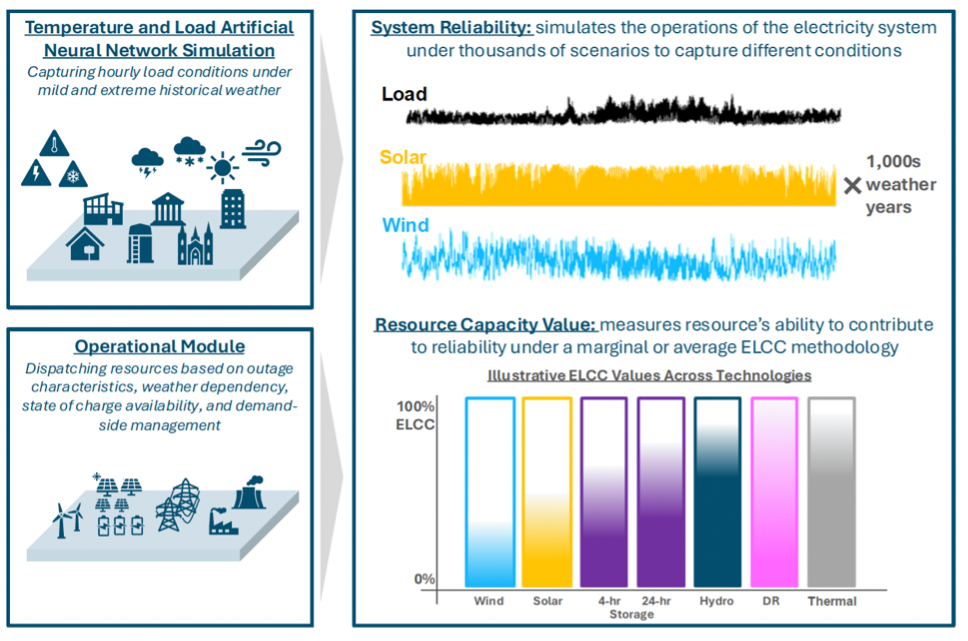
To study long-term resource needs through 2045, E3 used a combination of capacity expansion modeling and detailed reliability analysis in our RECAP and RESOLVE modeling platforms. The team optimized the regional power system to meet reliability and clean energy needs at least cost across different scenarios of load growth, resource costs, and policy requirements. E3 then evaluated how those resource portfolios perform under stressed conditions, including low hydro years, periods of low wind and solar output, and high demand events.
We find that, over the long run, the region can achieve deep carbon reductions while maintaining reliability and managing costs by investing in a diverse portfolio of resources, including energy efficiency, wind, solar, geothermal, transmission, and natural gas generation. Combining energy efficiency and renewable energy with new firm capacity provides the most affordable and resilient pathway across a wide range of scenarios modeled, representing a low-regrets strategy for the region.
Given limited near-term scalable alternatives to provide on-demand energy during critical reliability events, the analysis finds that new natural gas peaking capacity plays an important reliability role in the region. Flexible gas-fired resources provide backup during low hydro or low renewable periods, while turning off to avoid fuel purchases during periods when clean energy is plentiful, particularly later in the modeling period following a significant buildout of renewable energy resources. The results demonstrate that a limited amount of thermal capacity can complement high levels of clean energy to manage extreme conditions and multi-day reliability events.
Meeting future needs for the West of I-5 Corridor load centers, including Portland and Seattle, will require a combination of new in-region resources and expanded transmission to ensure that capacity can be delivered where and when it is needed. In the near-term, the region must address immediate reliability risks associated with load growth and retirements. In the mid- to long-term, the region will need to significantly increase annual resource additions to meet decarbonization goals with a balanced strategy that includes clean energy, firm capacity, and expanded delivery network capability. The study underscores the importance of flexible policies, coordinated regional planning, clear market accreditation signals, and transmission infrastructure development as critical pillars to enable the long-term portfolios studied.
To learn more about E3’s work in resource adequacy, please contact arne@ethree.com.
Download the study:
