

Energy and Environmental Economics is pleased to announce a new Distribution Planning and Technology practice, launched to address the growing technical, regulatory, and implementation challenges facing electric distribution systems. The practice is led by Eric Cutter, Snuller Price, Bob Zavadil, Jeremy Laundergan, and Jens Schoene and builds on E3’s long-standing work in utility integrated system planning, DER valuation, and regulatory analysis.
If you are attending DTECH this year, come meet the team in San Diego at our booth with Integral Analytics, #1839 inside Hall F.
Utilities are under increasing pressure to make large, long-term distribution investments amid aging infrastructure, growing resilience expectations, uncertain but potentially significant load growth, and affordability concerns. Distribution system costs are now the largest and fastest-growing component of utility capital spending, yet planning teams are often constrained by insufficient staffing, tools, and processes. At the same time, regulators and stakeholders are demanding greater transparency, stronger technical justification, and clearer links between long-term roadmaps and near-term capital approvals.
E3’s Distribution Planning and Technology practice is designed to help utilities respond with technical analysis that is practical and implementable. The team expands planning capacity for constrained utility organizations by adding in-house distribution engineering and power flow capability, enabling faster iteration and stronger technical support for public-facing distribution plans. A core focus is integrating distribution planning, load forecasting, DER adoption, and load flexibility into holistic, least-cost system planning frameworks, including explicit evaluation of wires and non-wires options to defer or right-size capital investments.
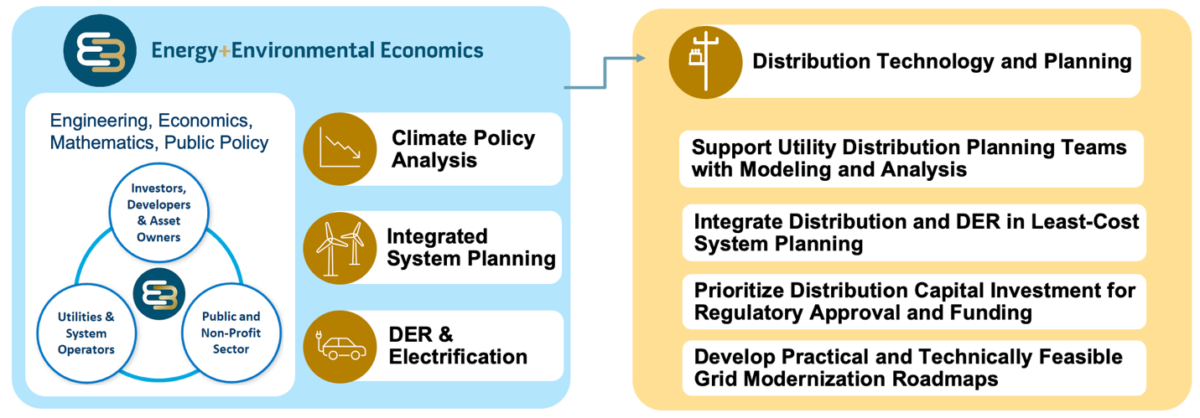
The practice also supports capital investment prioritization that can withstand regulatory and stakeholder scrutiny, helping utilities translate reliability, resilience, affordability, and equity objectives into integrated, regulatory-grade investment plans. In addition, the team supports development of grid modernization roadmaps that are technically feasible and practically implementable, focused on sequencing, operational constraints, and realistic funding pathways rather than aspirational vision statements.
The Distribution Planning and Technology practice extends E3’s long-standing work for the clean energy transition, bringing distribution planning into the same integrated framework E3’s uses for climate policy analysis, utility system planning, and DER and electrification cost-benefit analysis.
Project Examples
- Supporting a large investor-owned utility in translating electrification-driven load growth into feeder- and substation-level infrastructure needs, including the timing and drivers of required upgrades.
- Augmenting constrained distribution planning teams with scenario-based power flow analysis to evaluate long-term capital requirements under alternative load growth, DER adoption, and technology pathways.
- Developing temporal and geospatial load forecasts to identify where electrification, managed charging, or large new loads are most likely to drive distribution infrastructure needs.
- Conducting distribution system impact and hosting capacity analysis to support regulatory filings, stakeholder review, and capital approval proceedings.
- Integrating distribution and customer programs (DER) into system-wide planning studies, for holistic integrated system planning, DER strategy and long-term rate impacts.
Meet the team
The practice is led by senior technical experts with complementary, hands-on experience in distribution planning and grid operations.
Eric Cutter brings more than two decades of experience leading E3’s work on distributed energy resources, electric vehicles, and flexible load valuation. He has led development of DER cost effectiveness frameworks, avoided cost models, and distribution focused valuation approaches used by utilities and regulators across the U.S., with a particular focus on integrating DER, EV charging, and load flexibility into distribution planning and grid operations.
Profile and contact | LinkedIn
Snuller Price has over 25 years of experience helping utilities, regulators, and government agencies evaluate the economics of distributed energy resources and electrification. He has led foundational work on DER cost effectiveness, avoided costs, and time dependent valuation, including frameworks used for utility planning, distribution analysis, and regulatory decision making in California, New York, and other states.
Profile and contact | LinkedIn
Bob Zavadil brings over 45 years of experience in transmission and distribution planning, renewable integration, and grid modernization, including interconnection studies supporting more than 100 GW of wind and 50 GW of solar, and deep expertise in system stability, protection, and power quality. Profile and contact | LinkedIn
Jeremy Laundergan brings over 20 years of experience helping utilities modernize and optimize distribution systems and DER, with a focus on distribution engineering and technology planning that connects grid modernization strategy to implementation.
Profile and contact | LinkedIn
Jens Schoene brings an 18-year record leading complex power system studies, including grid transformation initiatives supporting distribution system state estimation, DER optimization, and operational forecasting.
LinkedIn
