


The Illinois Commerce Commission (ICC) Staff, supported by E3, has released the 2025 Draft Renewable Energy Access Plan (Draft REAP), a major step forward in the state’s strategy for achieving its ambitious decarbonization goals established under the Climate and Equitable Jobs Act (CEJA).
This update builds on the 2024 REAP by establishing a framework that allows the state to directly evaluate the comparative costs and benefits of generation and transmission investments across the state. In this cycle, the Draft REAP places increased emphasis on how transmission needs identified through the planning process can be translated into actual projects via existing and emerging regulatory pathways. The REAP maps a broad range of potential transmission system needs to the planning and approval mechanisms available within MISO and PJM, recognizing the importance of regional processes to deliver policy-aligned infrastructure.
Development of a First-of-its-Kind Integrated Planning Framework for Illinois
In support of the Draft REAP, E3 developed an Integrated Planning Framework that can co-optimize generation and transmission investments to meet state policy goals while maintaining system reliability. The framework enables the state to identify least-cost portfolios of generation and transmission infrastructure that achieve policy targets and will inform Illinois’ advocacy in regional planning processes.
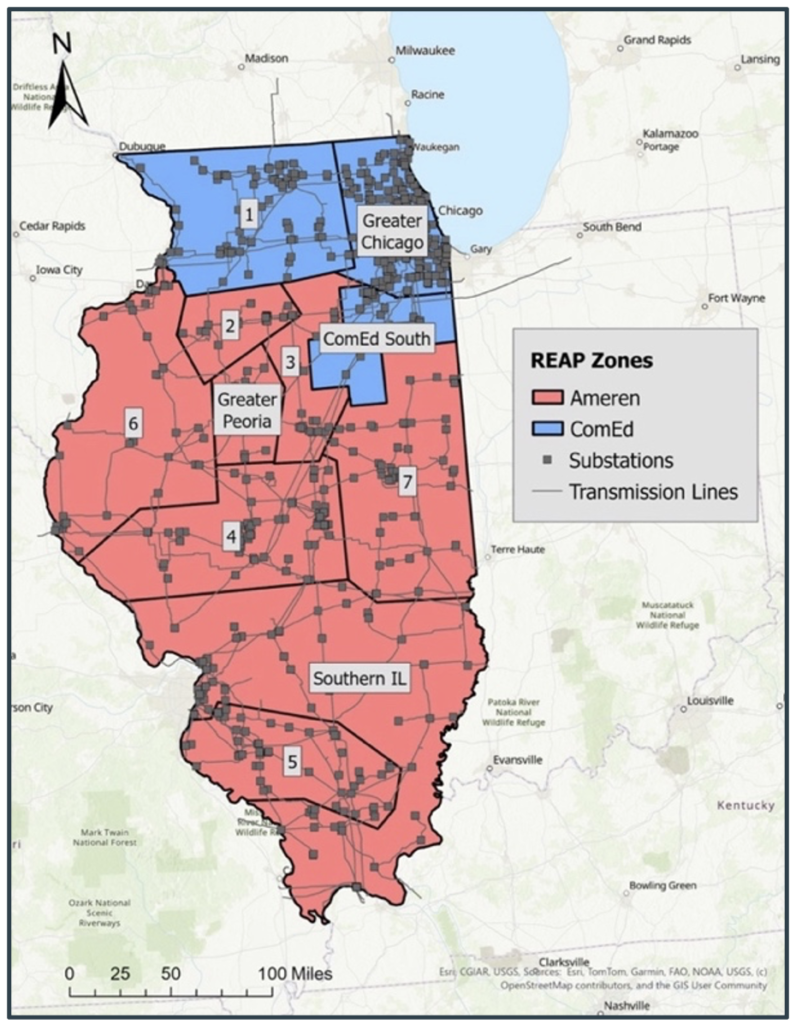
The framework spans both Regional Transmission Organizations (RTOs) that Illinois is a part of – the Midcontinent Independent System Operator (MISO) and the PJM Interconnection (PJM) – and maps candidate renewable energy zones (“REAP zones”) within Illinois to the state’s transmission system topology. This provides a proof of concept for linking renewable siting considerations, proactive headroom assessments, and long-term market and policy changes within a single planning construct. Future REAP cycles will continue to build on this framework by integrating the latest available data on transmission headroom and network upgrade costs and will lead to increasingly actionable results over time.
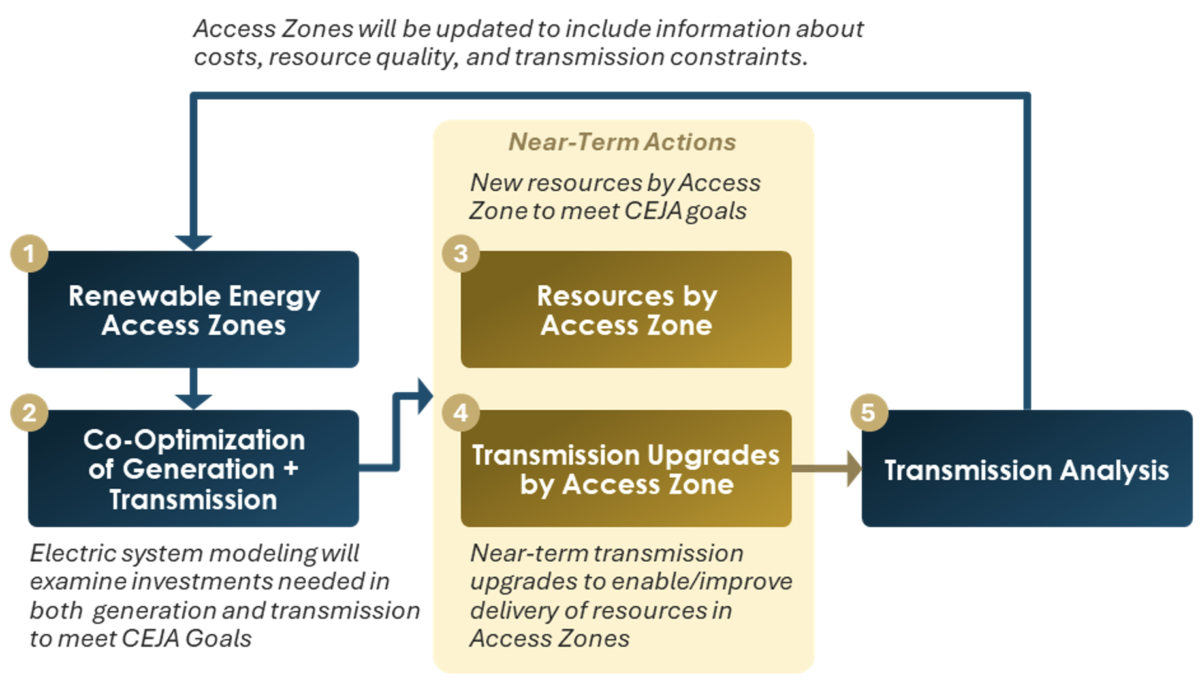
Key advancements and insights from this REAP include:
- Refinement of REAP Zones to Reflect Renewable Potential and Transmission System Constraints | The Draft REAP refines REAP zones to more accurately reflect Illinois’ transmission network topology. Resource potential, interconnection costs, and local transmission-related assumptions were developed for each zone, improving the alignment between renewable siting and grid constraints.
- Maximizing Grid Utilization with New Technologies | Meeting Illinois’ policy goals will require both conventional upgrades and advanced solutions. The Draft REAP establishes a practical framework for evaluating Advanced Transmission Technologies (ATTs) and Non-Wires Alternatives (NWAs) alongside traditional investments. An avoided-cost-based approach is used to compare ATTs and NWAs against conventional upgrades and highlights where these technologies may unlock near-term headroom or mitigate targeted constraints.
- Scenario-Based Modeling to Understand Long-Term System Needs and Land Use Impacts | To support long-lead-time transmission decisions, the Integrated Planning Framework evaluates multiple long-term scenarios representing different policy and system evolution pathways. This approach is designed to identify “least-regret” investments that perform well across a range of plausible futures and provides a foundation for incorporating additional uncertainties in future REAP cycles, including data center growth, electrification timing, and interregional transmission expansion.
- Positioning Illinois to Effectively Leverage Regional Processes and Markets | The REAP outlines multiple pathways for transmission development, including reliability and economic planning, long-term planning under FERC Order 1920, state-initiated approaches such as the State Agreement Approach, and local “supplemental” projects. The analysis highlights how each pathway balances speed, cost allocation, and alignment with Illinois’ policy-driven transmission needs, with recommendations to be refined in future REAP updates.
Read the report >
Contributing authors: Lakshmi Alagappan, Charlotte Fagan, Sam Schreiber, Alankar Sharma, Laura Shi, Kevin Steinberger, Thomas Strnad, Vignesh Venugopal, Parker Wild.
To learn more about this project, please contact kevin@ethree.com. To learn more about E3’s work in transmission, please contact lakshmi@ethree.com.
